
A practical guide to writing a nursing research proposal
Type: Support Article. Published: 27th Mar 2026
Still struggling with your nursing research proposal? We can help! We have qualified writing experts ready to assist, check out the nursing assignment help section for more details
A nursing research proposal is a structured plan that outlines a proposed study or literature review. It serves as both a roadmap and a persuasive case for why the research is needed.
It demonstrates your ability to think critically about a nursing problem. While also shows your ability to propose a systematic approach to investigating it, which is a key skill in evidence-based nursing practice.
Unlike a general essay, a research proposal is forward-looking. You are planning a research project, not reporting on completed work. Therefore, clarity, feasibility, and relevance to nursing are paramount.
This guide provides a comprehensive, step-by-step approach to crafting a high-quality nursing research proposal for an academic assignment. It covers everything from identifying a topic to outlining methodology, rationale, and expected outcomes. Throughout, we maintain an academic yet accessible tone, so even complex ideas are clearly conveyed.
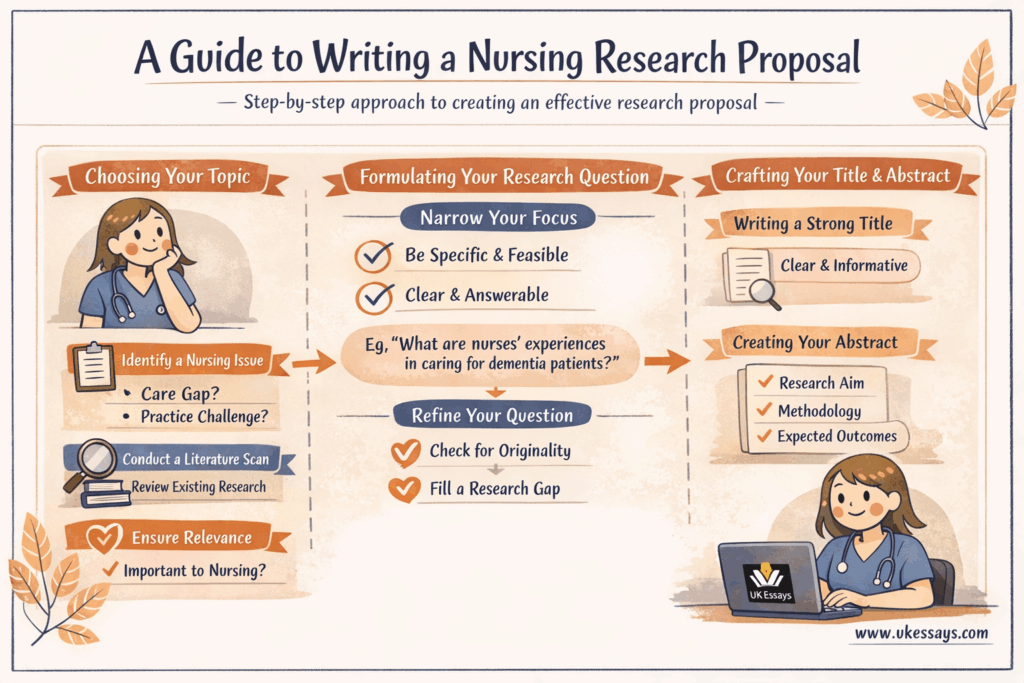
Choosing a relevant topic and formulating a research question
Every good research proposal starts with a strong idea. It often begins with curiosity about a nursing issue or problem you have observed in practice.
You might notice a gap in the care of a particular patient group. You might also see a recurring challenge in clinical practice. This often sparks a question.
For example, if you are interested in dementia care, you might ask: “What are the experiences of nurses caring for patients with dementia?” Such a question is appropriately focused yet significant, aligning with the assignment example.
To refine a raw idea into a focused research question, use critical thinking to narrow the scope. Ensure the question is answerable within the constraints of a student project (Iheanacho, n.d.).
This usually means being specific about who or what you will study and which aspect you will explore. Avoid an over-ambitious topic. Small-scale projects need a narrowly defined question. You should choose one that you can realistically address with the time and resources available (University of Nottingham, n.d.).
Once you have a tentative question, conduct a brief preliminary literature scan. Check that your question is original enough, or that it addresses a known gap. Also ensure that it matters to current nursing practice.
If similar research exists, you can justify how your study will build on it or differ from it. By the end of this stage, you should have a clear, concise question, or a few related sub-questions. This central question will guide the rest of your proposal.
Writing the title and abstract
The title of your proposal should be concise yet informative. You should craft a title that is clear, concise, and indicative of your project’s focus, so the reader immediately grasps the topic (Health Education England, 2021).
In nursing research, effective titles often mention the key population or issue. They also highlight the core phenomenon or variables of interest. For example, a title like “Exploring Nurses’ Experiences in Caring for Patients with Dementia: A Qualitative Study” is very specific. It clearly indicates both the context and the approach.
Aim for a title that is specific enough to convey your study’s scope. However, avoid unnecessary words or jargon.
Many student assignments do not require an abstract, but if yours does, this comes next. The abstract is a brief summary, usually around 150–250 words, that encapsulates the entire proposal.
It should succinctly state the research aim, the significance of the problem, and the proposed methodology. It should also mention the expected outcomes or implications. In essence, the abstract is your proposal in miniature. It highlights what you intend to study, how you will study it, and why it matters to nursing.
According to one guideline, a good abstract for a nursing proposal includes several key elements. These include the study’s aim, why the study is important, a description of the population or sample, and a statement of the design and how data will be analysed (Yale School of Nursing, 2016).
Since the abstract is the first thing readers will see, though it is often the last part you write, it needs to be clear and compelling. It should spark interest in your project.
Introduction and background
Identifying the problem and context
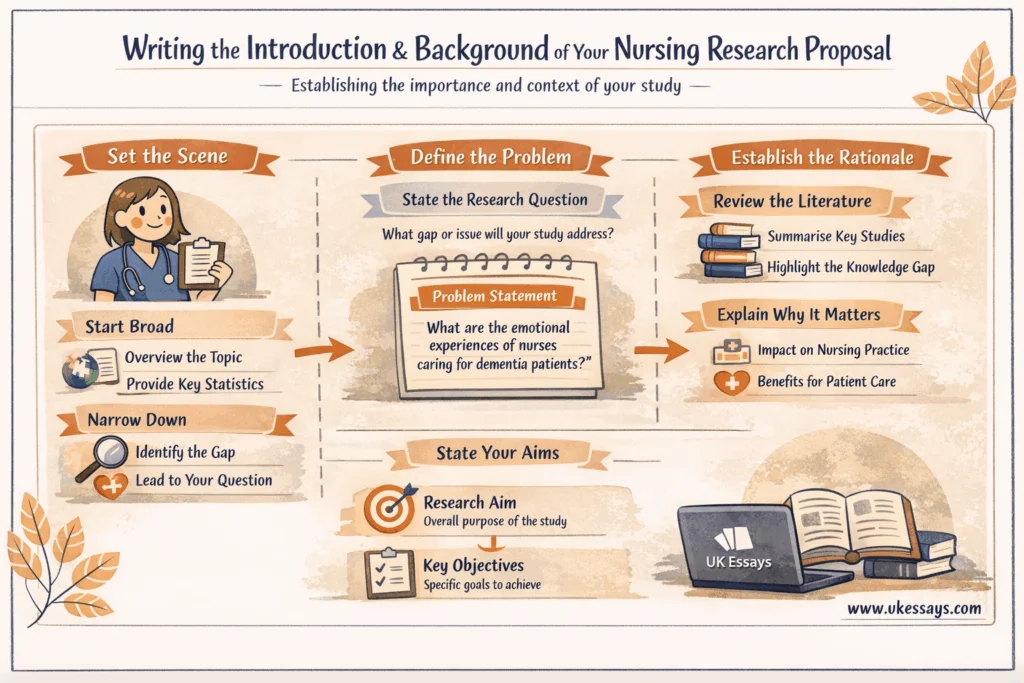
After the title and abstract, the proposal proper begins with an introduction that provides background and rationale for the study. This section should convince the reader that there is an important nursing problem worth investigating.
Begin with a broad overview of the issue. Then narrow down to your specific research question. This is often called a “funnel” approach.
For instance, if you are proposing a study on nurses caring for dementia patients, you might start by summarising the challenges of dementia care in nursing. Then you would highlight a particular gap or unanswered question. For example, you might note the lack of research on nurses’ emotional experiences in this role.
Next, clearly state the research problem or question your study will address. Present this in a clear problem statement, or by reiterating your research question. Frame it as a gap in current knowledge.
Establishing the rationale
In this introduction and background section, it is also essential to discuss relevant literature. This shows how your study fits into the existing evidence base.
Briefly review key findings from previous studies or reports on your topic. Identify what is still unknown or controversial. A strong proposal introduction includes a statement of the problem, a critique of pertinent literature, and an explanation of the study’s significance to nursing (Yale School of Nursing, 2016).
In a student proposal, this need not be a lengthy literature review. However, it should provide enough context to justify your proposed research. Make sure to cite recent and credible sources, such as journal articles and official reports, to support any claims about what is known or not known.
Finally, explicitly state the rationale for your study. Why is this research question important for nursing? Here you connect the issue to nursing practice or patient outcomes.
For example, you might argue that understanding nurses’ experiences with dementia patients could inform better support systems or training programmes. This could ultimately improve patient care.
If your proposal is for a literature review rather than a new study, the introduction still needs to justify why that review is needed. Perhaps the evidence on your topic is scattered or outdated, and synthesising it would help guide practice.
By the end of the introduction, the reader should clearly understand what you plan to research. It should also be clear why this topic matters in the context of nursing.
Aims and objectives
After setting the stage in the introduction, clearly state the aim of your study. If appropriate, add the specific objectives that will help achieve that aim.
The aim is a broad overall statement of what you intend to accomplish. The objectives break this down into focused, manageable pieces (Health Education England, 2021).
For example, your aim might be “to explore the experiences of nurses caring for patients with dementia in hospital settings.” Supporting objectives for this qualitative study might include identifying common challenges and stressors, exploring coping strategies and support mechanisms, and examining perceived impacts on nursing practice or patient care.
Present these objectives clearly. Each one should align with the central research question, and together they should address your overall aim.
In some proposals, especially quantitative ones, you might also state a hypothesis for one or more objectives. However, in a qualitative inquiry like our example, researchers usually stick with open-ended objectives rather than formal hypotheses.
The main point is that anyone reading this section understands exactly what you plan to find out. You have broken the inquiry into logical steps or questions. This provides a roadmap for the rest of the proposal, since you will design your methodology to meet these specific objectives.
Methodology
Study design and approach
The methodology section is the heart of your research proposal. It explains exactly how you plan to conduct the study.
This part should be detailed and logically structured. It should convince the reader that your approach is sound and feasible. You need to describe the research design, the target sample, and the methods of data collection. You must also explain how you will analyse the data.
Start by stating the overall design of your study and the methodological approach. Are you doing a qualitative study, a quantitative experiment, a survey, or something else?
For example, in our dementia care proposal, you might choose a qualitative design because you are exploring personal experiences. You might then specify a particular approach, such as a phenomenological study or an exploratory descriptive study.
Explain briefly why this design is suitable for answering your research question. This shows the rationale behind your choice. If you are proposing a quantitative study, state whether it is, for example, a randomised controlled trial, a cross-sectional survey, or a cohort study, and explain why that design fits the question.
Sampling and recruitment
Next, describe your sample. Explain who or what will provide the data for your study.
In a nursing research proposal involving human participants, specify the population of interest and the sampling strategy. For the qualitative dementia-care study, you might decide to recruit registered nurses who have at least one year of experience in caring for patients with dementia.
You could use purposive sampling to select nurses from a particular hospital ward or care home. This would help ensure they have relevant experience. State the anticipated sample size and justify it briefly. For example, you might suggest approximately 10–12 nurses, which is appropriate for an in-depth qualitative study.
For a quantitative study, you would likely aim for a larger sample size. You might then employ a random sampling method or use existing datasets.
Mention how you will recruit participants. For example, you might send workplace email invitations, post notices on professional bulletin boards, or recruit through a nursing association. Also outline any inclusion and exclusion criteria.
If your project does not involve human participants, describe the source of your data. Explain how you will select those data points or materials.
Data collection methods
Detail the methods you will use to collect data, making sure they align with your objectives. In the qualitative example, a common method is conducting interviews.
You might plan to hold semi-structured interviews of about 30–60 minutes with each nurse participant. Describe where and how these interviews will take place, perhaps face-to-face in a private room at the hospital or via a secure video call. You should also outline the general areas you will cover.
For example, you might explore topics such as the challenges nurses face, their emotional responses, and the support they feel they need in the context of dementia care. The same principle applies if you use focus groups or observations. Outline how you will carry these out and what you will be looking for.
For a quantitative study, data collection could involve tools such as surveys, questionnaires, or biomedical measurements. You might distribute a standardised questionnaire to 100 nurses and collect responses. You might also measure certain health indicators before and after an intervention.
Be sure to mention any established instruments by name, and note their reliability or validity if known. Also address how you will record and manage the data. For interviews, will you audio-record and transcribe them? For surveys, will data be collected anonymously online and stored in a password-protected file?
Data analysis plan
Explain how you will analyse the data after it has been collected. This step is critical to answering your research question.
For qualitative data, you might use thematic analysis to identify patterns and themes in the interview transcripts. Describe the process in simple terms. For example, you will code the transcripts line by line to tag significant pieces of information. You will then group those codes into broader themes that reflect common experiences.
It is also wise to mention how you will ensure rigour in the analysis. You might have a second researcher or peer review some of the coding. You might also use participant feedback on the findings, often called member checking, to validate the themes.
For quantitative data, specify the statistical tests or analytical techniques you will use. Link each test to a specific objective. For instance, you might state that, to compare stress levels between two groups of nurses, you will use an independent t-test. Or, to examine the relationship between years of experience and empathy scores, you will calculate a Pearson correlation.
If your study involves more complex analysis, such as multiple regression or specialised software for qualitative data, mention it. However, keep the explanation at a level that a general reader can follow.
Methodology for a literature review project
If your assignment is a literature review rather than a study with new data, you still need a clear methodology. This should detail how you will conduct the review.
Start by defining the scope of the review. For example, you might propose an integrative literature review of research on nursing interventions for dementia patients. Then outline your search strategy, including which databases you will search, such as CINAHL, MEDLINE, or PsycInfo, and which keywords or terms you will use.
Next, specify your inclusion and exclusion criteria for selecting literature. You might include studies from the last 10 years, written in English, and focused on registered nurses. You would exclude articles about other professional groups or unrelated settings.
Clarify how you will screen the literature. This often involves reading titles and abstracts first, then reading the full texts of those that appear relevant. Mention if you will use a flow chart, such as the PRISMA diagram, to track the number of articles included and excluded at each stage.
After selecting the relevant literature, explain how you will extract and synthesise information from the sources. Will you summarise and theme the findings? Will you compare statistical results? Describe whether you plan to organise the review by themes, chronology, or another structure.
Also note how you will appraise the quality of the studies you include. For instance, you might use a tool like the CASP checklist to assess each study’s rigour. Then you can decide how much weight to give each study in your conclusions.
Ethical considerations and feasibility
Protecting participants and data
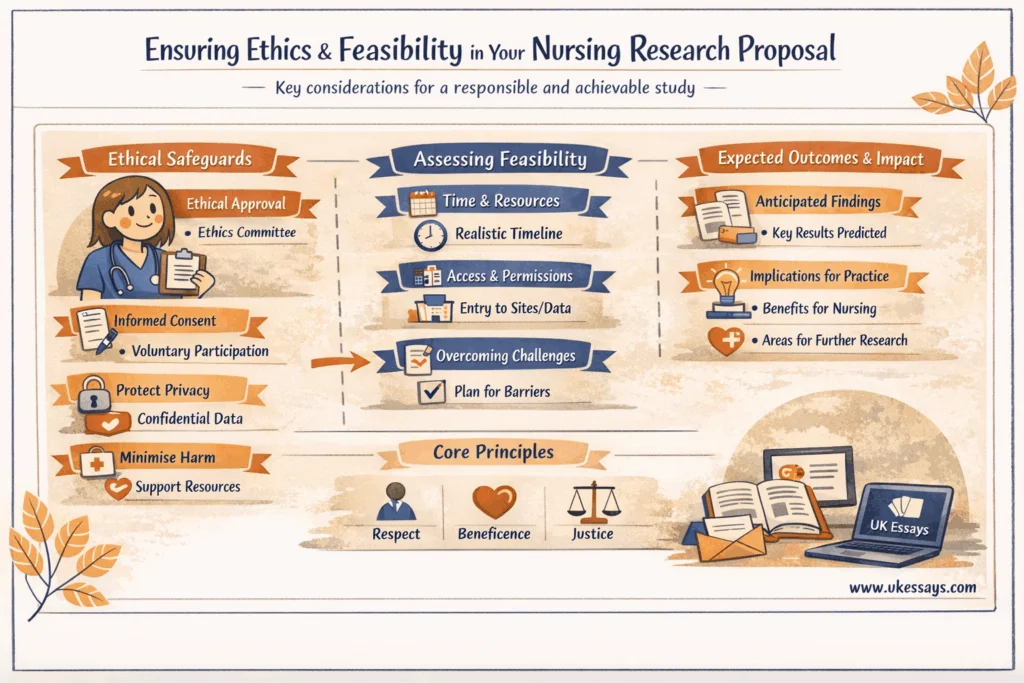
No nursing research proposal is complete without addressing ethics. If your research involves human participants, which is common in nursing studies, you must show awareness of ethical safeguards.
This means explaining how you will obtain ethical approval from the relevant ethics committee or review board before starting. For example, a student project might require approval from a university research ethics committee or an NHS Research Ethics Committee.
You should state that you will obtain informed consent. You will explain the study to participants, ensure they understand it, and confirm that participation is voluntary. They should also be able to withdraw at any time.
Address how you will protect participants’ privacy and confidentiality. For instance, you might indicate that you will conduct interviews in a private setting, anonymise the data by replacing names with codes, and store all records securely.
Also discuss any potential risks or discomforts to participants and how you will minimise them. In our dementia care example, discussing challenging experiences might be emotionally taxing for nurse participants. You could therefore note that you will provide information on support resources or offer a debrief session after the interviews.
Emphasise that your study adheres to core ethical principles such as respect for persons, beneficence, and justice.
Practical feasibility
If your project is a literature review with no new human data, ethical considerations are less complex. Even so, you should conduct your scholarship honestly and diligently. For example, you should properly cite all sources to avoid plagiarism and present findings objectively without misrepresentation.
Finally, consider the feasibility of your proposed research. Indicate that you have thought about practical constraints such as time, access, and resources, and that your plan is realistic.
For instance, you might note that the data collection will be feasible within a single academic term. You might also note that you have access to the population or records you intend to study.
If any potential barriers exist, such as needing organisational permission to contact nurses at a hospital, mention how you will address them. Demonstrating feasibility reassures the reader that the project can actually be carried out successfully. It shows that you have done the necessary planning to make the research achievable on a small scale.
Expected outcomes and implications
In this final section of the proposal, discuss the expected outcomes of your research and their potential implications for nursing practice or knowledge. Here, you are describing what you anticipate finding and why it will matter.
Clearly outlining expected outcomes helps the reader understand what the study aims to achieve. It also highlights the study’s significance (Alhassan et al., 2025).
For example, you might predict that your qualitative study will yield a set of thematic insights. Nurses in your study might commonly describe feelings of frustration. They might also highlight coping strategies and sources of support that help them care for dementia patients effectively.
In a quantitative study, an expected outcome could be a measurable difference or relationship. For example, nurses who receive dementia-care training might report lower burnout scores than those who do not.
Make no assumptions
Be careful not to assume your results in advance or introduce bias. However, do show that you have grounded expectations based on background reading. Each expected outcome should connect back to an objective or research question you outlined earlier.
After stating the likely findings, articulate the implications of those findings. Explain how this new knowledge could be used in nursing. Will it help improve patient care, inform policy, guide education, or point to areas for further research?
For instance, if you expect to find that lack of support is a major theme among nurses, the implication might be that healthcare administrators need to implement better support and mentoring programmes on dementia units. If your expected outcome is a positive effect of an intervention, the implication could be that the intervention should be adopted more widely or tested further.
You can also mention any plans to share or apply the findings. For example, will you present them to your department, publish an article, or integrate the results into practice guidelines? This shows that your work will not sit on a shelf but will contribute to the field.
In summary, the proposal should end by reinforcing what will be learned if the study is done and why that knowledge will be valuable. By doing so, you leave the reader convinced that your nursing research proposal, if executed, will yield meaningful benefits for practice or future scholarship.
Conclusion
Writing a nursing research proposal is a valuable exercise that integrates your understanding of research methods with real-world nursing issues. By carefully choosing a focused topic, formulating a clear question, and planning a rigorous methodology, you set a strong foundation for your project.
This approach helps ensure the project can advance knowledge and improve practice. Remember to maintain a logical structure throughout your proposal and support your decisions with evidence or rationale. This demonstrates scholarly thinking.
Pay attention to clarity and detail. A well-written proposal uses straightforward language, while still remaining formal, and moves clearly from one section to the next.
Before finalising your assignment, proofread your work to eliminate any ambiguities or errors. Also ensure that you have met all the requirements, such as word count and formatting guidelines.
A strong, well-researched proposal not only fulfils the assignment criteria but also prepares you for the possibility of actually conducting the study. It equips you to contribute valuable insights to nursing. With a well-crafted proposal, you not only satisfy your academic requirements but also position yourself to make a meaningful contribution to evidence-based nursing practice.
Further reading
If you want to build on this topic, it is useful to read about the PICO framework. Although it is often linked to evidence-based practice, it can also help you sharpen a research question by making the population, intervention, comparison, and outcome more explicit.
It is also worth exploring CASP appraisal tools. These are especially useful if your proposal includes a literature review, because they help you assess the quality, rigour, and relevance of existing studies in a structured way.
Another closely related area is the PRISMA framework. This is particularly helpful if you are planning a review-based project, as it improves transparency in how sources are searched, screened, and selected.
Still struggling with your nursing research proposal? We can help! We have qualified writing experts ready to assist, check out the nursing assignment help section for more details
References
- Alhassan, M., Dorri, R., and Al-Omari, E. (2025) Crafting Nursing Research Proposals: A Step-by-Step Guide to Best Practices. Preprints 2025, 202504.0549. Available at: https://www.preprints.org/manuscript/202504.0549/v1 (Accessed: 24 July 2025).
- Health Education England (2021) ‘Writing a research proposal: planning and communicating your ideas effectively’. NHS Library and Knowledge Services. Available at: https://library.hee.nhs.uk/learning-academy/learning-zone/research-toolkit/research-toolkit-step-5 (Accessed: 24 July 2025).
- Iheanacho, P.N. (n.d.) Writing a Research Proposal and a Research Protocol in Clinical Nursing Research. University of Nigeria, Enugu Campus. Available at: https://media.tghn.org/articles/WRITING_A_RESEARCH_PROPOSAL__AND_A_RESEARCH_PROTOCOL_Dr_Iheanacho.pdf (Accessed: 24 July 2025).
- University of Nottingham (n.d.) ‘Guidance on writing an outline research proposal – School of Health Sciences’. Available at: https://www.nottingham.ac.uk/healthsciences/postgraduate/apply/research-proposal.aspx (Accessed: 24 July 2025).
- Yale School of Nursing (2016) ‘Research/Clinical/Student Project Proposal Guidelines’. Yale University. Available at: https://nursing.yale.edu/researchclinicalstudent-project-proposal-guidelines (Accessed: 24 July 2025).
Browse Our Support Articles
Choose an option below to browse all support articles in that category.