
RIBA stages guide
Info: 4415 words (18 pages) Study Guides
Published: 15 Apr 2026
UK Essays writing support
Writing an assignment about the RIBA stages?
We’ll write a complete model answer to your assignment question on the RIBA stages.
Send us your question and, if you wish, any marking criteria. An experienced specialist in your subject will write your model answer from scratch.
All our writers hold at least a 2:1 degree from a reputable university. Most hold a master’s degree or PhD, and/or have teaching experience.
The Royal Institute of British Architects (RIBA) Plan of Work is the definitive framework for organising the process of briefing, designing, constructing, and operating building projects in the United Kingdom. First published in 1963, it has become the most widely adopted process model in the British construction industry, used by architects, clients, engineers, quantity surveyors, and project managers alike. This guide provides a thorough examination of each stage, its purpose, key tasks, and practical significance.
What is the RIBA plan of work?
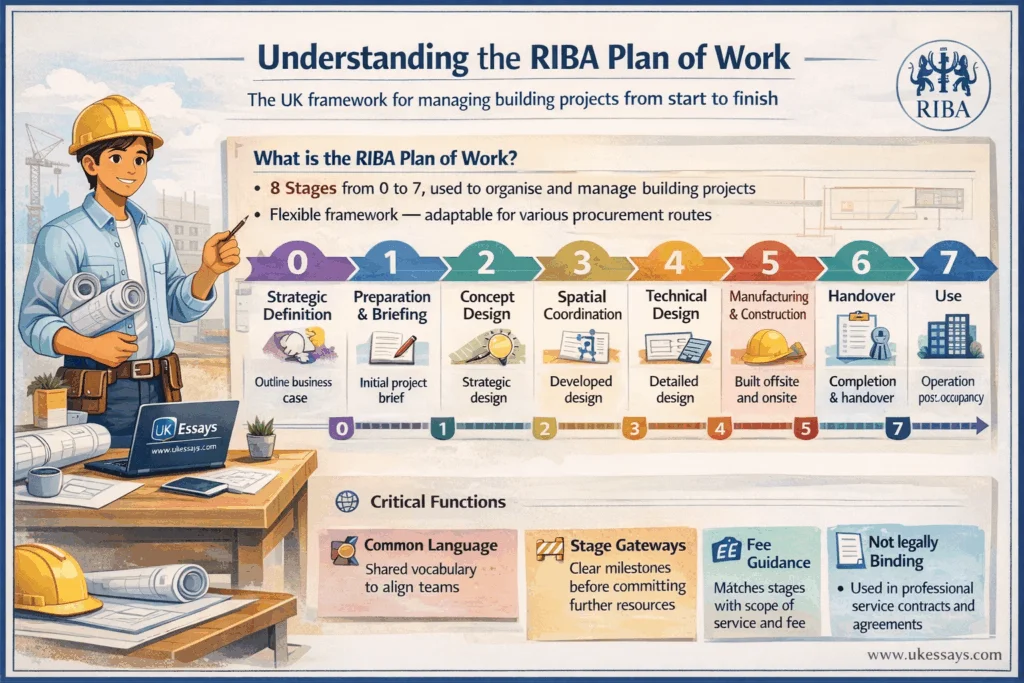
The RIBA Plan of Work provides a shared language and framework that divides the building delivery process into eight stages, numbered 0 through 7. Each stage identifies core tasks, information exchanges, procurement milestones, and programme considerations. It does not prescribe a single procurement route; rather, it is sufficiently flexible to accommodate traditional contracts, design-and-build, management contracting, and emerging collaborative models such as integrated project delivery.
The Plan of Work serves several critical functions:
Coordination – It aligns the activities of multidisciplinary teams around common stage boundaries.
Communication – It provides a shared vocabulary, reducing misunderstanding between client and design team.
Fee structuring – Architectural appointments commonly reference RIBA stages to define scope of service and fee instalments.
Quality management – Stage gateways encourage review, sign-off, and informed decision-making before committing further resources.
The framework is not legally binding in itself, but it underpins many standard forms of appointment, including the RIBA Professional Services Contracts and the suite of agreements published by the Joint Contracts Tribunal (JCT).
Historical development
The Plan of Work has undergone several significant revisions since its inception:
| Year | Key changes |
|---|---|
| 1963 | Original publication, establishing a linear sequence of work stages (A–M). |
| 1967–2007 | Periodic revisions reflecting changes in procurement, technology, and regulation. |
| 2013 | Major overhaul: letter-coded stages replaced with numbered stages 0–7; digital plan of work tool launched; sustainability considerations embedded. |
| 2020 | Current edition: introduction of “spatial coordination” at Stage 3; strengthened emphasis on outcomes, building safety, and sustainability; alignment with the UK Building Information Modelling (BIM) Framework. |
The shift from letter codes to numbered stages in 2013 was more than cosmetic. It reflected a fundamental reorientation towards outcome-based thinking, with Stage 0 (Strategic Definition) acknowledging that the decision to build at all requires rigorous scrutiny, and Stage 7 (Use) recognising that a building’s performance during occupation matters as much as its design (RIBA, 2020).
The 2020 revision: key themes
The 2020 edition introduced several important refinements that practitioners and students must understand:
Sustainability
Each stage now carries explicit sustainability checkpoints. The Plan of Work encourages teams to set measurable sustainability outcomes at Stage 0, test them through design, and verify them in use. This aligns with RIBA’s 2030 Climate Challenge, which sets operational energy, embodied carbon, and potable water targets for chartered practices.
Building safety
Published in the wake of the Grenfell Tower tragedy (2017) and Dame Judith Hackitt’s Independent Review of Building Regulations and Fire Safety, the 2020 Plan of Work incorporates gateway points that mirror the building safety regime subsequently enacted in the Building Safety Act 2022. The concept of a “golden thread” of information—maintained from inception through occupation—is embedded across every stage (Hackitt, 2018).
Digital technology and information management
The plan aligns with the UK BIM Framework (based on ISO 19650 series) and emphasises the importance of an information management process running in parallel with the design process. At each stage, the team should produce information to an agreed level of detail and coordinate it within a common data environment.
Procurement flexibility
The 2020 Plan of Work acknowledges that stage boundaries shift depending on the chosen procurement route. Under design-and-build arrangements, for example, the employer’s design team may complete work to Stage 3 or partway through Stage 4 before the contractor’s team assumes responsibility. The plan provides overlay guidance for different procurement strategies.
Stage 0 – Strategic definition
Purpose
Stage 0 exists to ensure that the right project is identified before any design work begins. It asks a deceptively simple question: is a building project the best way to achieve the client’s strategic objectives?
Key tasks
Review the client’s business case. The design team (or a project manager acting on the client’s behalf) examines whether the stated need can be met through refurbishment, extension, acquisition of an existing building, or even non-construction solutions such as changes to working practices.
Identify the strategic brief. This high-level document captures the client’s organisational objectives, aspirations, budget envelope, and programme expectations. It is deliberately broad; detailed room-by-room requirements come later.
Assess site options. Where the site is not predetermined, Stage 0 includes high-level site appraisal, considering planning constraints, infrastructure, environmental sensitivity, and acquisition costs.
Define the project programme. An initial programme establishes key milestones, including any immovable dates (e.g., lease expiry, funding deadlines).
Establish the project team. The client determines which consultants to appoint and under what terms. Procurement strategy discussions begin here.
Stage outcome
A clear, endorsed strategic brief and a decision to proceed to Stage 1. If the strategic review concludes that a construction project is not warranted, the process may stop here—a valid and valuable outcome.
Practical note
Students often overlook Stage 0 in essays and design studio projects, jumping straight to site analysis and concept sketches. In professional practice, however, Stage 0 is where some of the most consequential decisions are made. A poorly defined strategic brief can lead to months of abortive design work. As the Construction Industry Council’s guidance on briefing observes, investment in early-stage clarity yields disproportionate savings later (CIC, 2015).
Stage 1 – Preparation and briefing
Purpose
Stage 1 develops the strategic brief into a detailed project brief and assembles the information needed to begin design. It is the bridge between the client’s aspirations and the architect’s creative response.
Key tasks
Develop the project brief. The project brief translates strategic objectives into measurable requirements: spatial needs, functional relationships, environmental performance targets, accessibility standards, and quality benchmarks. It should be a living document, refined as understanding deepens.
Undertake feasibility studies. These may include massing studies, accommodation schedules, cost plans (RIBA Stage 1 cost plans are typically at order-of-cost level), and high-level environmental assessments.
Carry out site appraisal. Detailed site investigations—topographical surveys, ground investigations, ecological surveys, arboricultural assessments, heritage appraisals, and flood risk analysis—begin here, although some may continue into Stage 2.
Review planning context. The team examines the local plan, supplementary planning documents, national planning policy, and any site-specific designations (conservation area, listed building curtilage, flood zone, etc.). Pre-application discussions with the local planning authority commonly take place at this stage.
Agree the project budget. The quantity surveyor or cost consultant prepares an initial cost plan, benchmarked against comparable projects.
Establish the responsibility matrix. Using a design responsibility matrix (sometimes called a scope of services matrix), the team clarifies who is responsible for what at each stage, reducing the risk of gaps or duplication.
Set sustainability targets. In line with the 2030 Climate Challenge, teams should establish operational energy and embodied carbon targets at this point.
Stage outcome
An approved project brief and a set of site and contextual information sufficient to commence concept design. The client should formally sign off the brief, as subsequent changes become increasingly costly.
Relationship to the briefing process
Briefing is not a single event but a progressive activity. The RIBA Plan of Work distinguishes between the strategic brief (Stage 0), the project brief (Stage 1), and the ongoing refinement of requirements that occurs through design development. Effective briefing requires genuine dialogue between client and architect; it is not simply a matter of the client issuing instructions and the architect complying (Blyth and Worthington, 2010).
Stage 2 – Concept design
Purpose
Stage 2 is where architectural creativity comes to the fore. The architect develops an initial design concept that responds to the project brief, site context, and regulatory framework.
Key tasks
Prepare the concept design. This typically includes site plans, floor plans, sections, elevations, and three-dimensional views at an appropriate scale (commonly 1:200 or 1:100). The design establishes the building’s form, massing, orientation, and spatial organisation.
Develop the structural and building services strategy. The structural engineer proposes a structural system (frame type, foundation approach, stability strategy), and the building services engineer outlines the environmental strategy (heating, ventilation, cooling, lighting, and energy generation).
Prepare an outline specification. Key materials, construction systems, and performance standards are identified, though not yet specified in full detail.
Update the cost plan. The quantity surveyor prepares a Stage 2 cost plan, typically using elemental cost analysis benchmarked against the approved budget.
Undertake design reviews. Internal design reviews, client presentations, and, where applicable, design review panels (such as local authority design panels or Design Council reviews) test the quality and robustness of the concept.
Prepare for planning. If a pre-application submission has not yet taken place, it is essential at this stage. The team may also begin preparing for formal planning submission, particularly for outline applications.
Stage outcome
An approved concept design, together with a cost plan demonstrating that the project remains within budget. The client’s sign-off at this gateway is critical; significant changes to the concept after this point can cause substantial programme delay and abortive cost.
Design quality and precedent
Stage 2 is the point at which the architectural idea is most clearly legible. It is the stage most frequently discussed in design criticism, professional awards submissions, and academic discourse. The concept should demonstrate a clear rationale connecting the brief, the site, and the design response. As the architectural theorist Peter Zumthor has argued, the power of architecture lies in the quality of its fundamental idea, not in the accumulation of detail (Zumthor, 2006). Students should note, however, that a concept is only as strong as its capacity to survive the rigours of technical development. A beautiful diagram that cannot be built, serviced, or afforded is of limited value.
Stage 3 – Spatial coordination
Purpose
Stage 3 is perhaps the most technically demanding stage for the design team. Renamed from “Developed Design” in the 2013 edition, the 2020 title—”Spatial Coordination”—emphasises the primary task. Ensuring that the architectural, structural, and building services designs are spatially coordinated before technical design begins.
Key tasks
Develop the design in detail. The architect refines the concept design, resolving floor layouts, ceiling zones, partition types, door and window positions, and internal finishes. Drawings are typically produced at 1:100 and 1:50.
Coordinate spatially. The structural engineer finalises column positions, beam depths, floor zones, and slab build-ups. The building services engineer confirms duct routes, riser positions, plant room sizes, and ceiling void depths. The architect integrates all of this into a coordinated set of drawings and models.
Resolve key technical interfaces. Critical junctions—such as the interface between structure and cladding, the relationship between services routes and fire compartmentation, and the coordination of drainage with the structural slab. This must be resolved at this stage, not left to Stage 4.
Prepare for planning submission. Full or reserved matters planning applications are commonly submitted during or at the end of Stage 3. The submission package typically includes design and access statements, environmental impact assessments (where required), transport assessments. as well as other supporting documents mandated by local validation checklists.
Update the cost plan. The Stage 3 cost plan is more detailed, typically based on measured approximate quantities, and must confirm that the project remains within budget.
Undertake building regulations pre-consultation. Early engagement with the building control body (whether local authority or approved inspector) helps identify regulatory issues before they become embedded in the technical design.
Stage outcome
A spatially coordinated design with planning permission secured (or submitted). The design should be sufficiently resolved to allow technical design to proceed without fundamental changes. Under a design-and-build procurement route, this is often the point at which the employer’s requirements are fixed and responsibility transfers to the contractor.
The significance of coordination
The renaming of this stage in 2020 was deliberate and significant. Coordination failures—where structural members clash with duct routes, or services penetrate fire compartment walls without adequate protection. These are among the most common and costly sources of error in construction. The Farmer Review of the UK construction labour model highlighted poor coordination as a systemic weakness, contributing to waste, delay, and quality defects (Farmer, 2016). Stage 3’s emphasis on spatial coordination is intended to address this directly, encouraging teams to resolve interfaces in the digital model before they become problems on site.
Stage 4 – Technical design
Purpose
Stage 4 produces the technical information needed to manufacture and construct the building. It is the stage at which architectural intent is translated into buildable detail.
Key tasks
Prepare technical drawings and specifications. The architect produces detailed plans, sections, elevations, and construction details, typically at 1:20, 1:10, and 1:5 as appropriate. The specification—whether in National Building Specification (NBS) format or bespoke—defines materials, workmanship standards, and performance requirements.
Complete specialist subcontractor design. Elements such as curtain walling, structural steelwork connections, precast concrete, mechanical and electrical installations, and lift systems are typically designed by specialist subcontractors. Their design must be coordinated with the architect’s and engineer’s work.
Finalise building regulations submission. A full plans application (or initial notice, if an approved inspector is used) is submitted with sufficient technical detail to demonstrate compliance with the Building Regulations 2010 (as amended).
Prepare construction information. The production of information suitable for tendering and construction is the core output of Stage 4. Under traditional procurement, this information forms part of the tender documentation.
Update the cost plan. The Stage 4 cost plan is based on detailed measurement and specification, providing a pre-tender estimate against which tender returns can be assessed.
Stage outcome
A complete set of production information—drawings, specifications, schedules, and coordinated models—sufficient for construction. Under traditional procurement, the project is now ready to tender. Under design-and-build, much of Stage 4 may be undertaken by the contractor’s design team.
The role of the architect in technical design
There is an ongoing professional debate about the extent to which architects should remain involved in technical design, particularly under design-and-build procurement. Where the contractor’s team may assume lead design responsibility from Stage 3 onwards. RIBA has consistently argued that architect involvement through Stage 4 is essential to maintaining design quality and ensuring that the original design intent is not diluted or lost during technical development. The Architects Registration Board (ARB) and RIBA codes of conduct both require architects to act competently and in the public interest. Relinquishing control of technical design without adequate safeguards may compromise both (RIBA, 2019).
Stage 5 – Manufacturing and construction
Purpose
Stage 5 covers the physical construction of the building, from site mobilisation to practical completion. Although the architect’s role changes—from lead designer to contract administrator, employer’s agent, or monitoring role, depending on the procurement route—it remains vitally important.
Key tasks
Administer the building contract. Under traditional procurement, the architect typically acts as contract administrator, issuing instructions, certifying payments, assessing extensions of time, and administering the change control process. Under design-and-build, the client may appoint the architect as employer’s agent.
Respond to site queries. Requests for information (RFIs), technical queries, and proposed material substitutions require prompt and considered responses. Delay in responding to RFIs is a well-documented cause of construction delay and claims.
Inspect the works. The architect carries out periodic site inspections (not supervision—a legally significant distinction) to monitor quality and progress. Inspection frequency and scope should be defined in the appointment.
Review specialist subcontractor information. Submittals, shop drawings, and samples require review against the design intent.
Manage design changes. Variations are almost inevitable. The architect must assess the design, programme, and cost implications of proposed changes and issue revised information through the formal change control process.
Monitor building safety. For higher-risk buildings (as defined by the Building Safety Act 2022), the principal designer has statutory duties during construction to manage building regulations compliance and ensure the golden thread of information is maintained.
Stage outcome
The building reaches practical completion: the works are complete to the extent that the client can take possession and use the building for its intended purpose, notwithstanding minor snagging items.
Practical completion and defects
Practical completion is a contractual milestone, not defined in statute. Its precise meaning has been shaped by case law, most notably Jarvis and Sons Ltd v. Westminster Corporation [1970] and Emson Eastern Ltd v. EME Developments Ltd [1991]. Following practical completion, a defects liability period (typically 12 months) begins, during which the contractor is obliged to return and remedy defects. The architect compiles a schedule of defects and certifies making good at the end of this period.
Stage 6 – Handover
Purpose
Stage 6 ensures that the completed building is handed over to the client in a condition that enables effective occupation and operation. It addresses a longstanding weakness in the industry: the gap between what is designed and what is delivered in terms of operational performance.
Key tasks
Compile the building manual. This document (or digital equivalent) contains all information needed to operate and maintain the building. As-built drawings, operation and maintenance manuals, health and safety file, fire safety information, commissioning records, and warranties.
Conduct building services commissioning. Mechanical, electrical, and controls systems must be commissioned, tested, and balanced to ensure they perform as designed. Poor commissioning is one of the principal causes of the “performance gap”—the difference between predicted and actual energy consumption.
Undertake seasonal commissioning. Some systems cannot be fully commissioned until seasonal conditions allow (e.g., cooling systems in winter). The commissioning process may therefore extend into Stage 7.
Deliver user training. Building occupants and facilities managers need training on how to operate building systems efficiently. Without this, even well-designed buildings perform poorly.
Conclude contractual matters. Final account negotiation, release of retention, and certification of making good of defects are completed during this stage.
Stage outcome
The client takes full operational control of the building, equipped with all the information and training needed to use it effectively. The building safety regulator, for higher-risk buildings, must issue a completion certificate before occupation (Building Safety Act 2022).
Stage 7 – Use
Purpose
Stage 7 extends the architect’s concern beyond the completion of construction into the operational life of the building. It reflects a growing recognition that design quality should be measured not by what a building looks like on completion day, but by how it performs over decades of use.
Key tasks
Undertake post-occupancy evaluation (POE). Systematic assessment of building performance in use—covering energy consumption, thermal comfort, user satisfaction, acoustic quality, and functionality—provides invaluable feedback for the design team and the client. POE should be conducted at intervals (commonly 1, 3, and 5 years after occupation).
Monitor energy performance. Comparison of actual energy consumption against design predictions helps identify commissioning deficiencies, operational inefficiencies, and design lessons for future projects.
Facilitate ongoing maintenance. The building manual prepared at Stage 6 supports planned maintenance programmes, but the architect may also be engaged to advise on adaptations, refurbishments, or extensions.
Contribute to facilities management. In some cases, the architect’s understanding of the design intent can inform facilities management strategies, particularly in complex or heritage buildings.
Update the information model. Where BIM is used, the operational model (sometimes called the asset information model) should be maintained and updated throughout the building’s life, supporting facilities management and future interventions.
Stage outcome
A building that performs well in use, with lessons learned feeding back into the design team’s body of knowledge. The circular nature of this feedback—from Stage 7 back to Stage 0 of future projects—is one of the Plan of Work’s most important conceptual contributions.
The performance gap
Research consistently shows that buildings consume significantly more energy in operation than their design-stage predictions suggest—often 1.5 to 3 times more (de Wilde, 2014). Post-occupancy evaluation is the primary mechanism for understanding and closing this gap. Despite its importance, POE is still not routinely commissioned by clients or offered by architects. RIBA’s inclusion of Stage 7 as a formal stage, rather than an afterthought, is intended to change this culture.
Cross-cutting themes
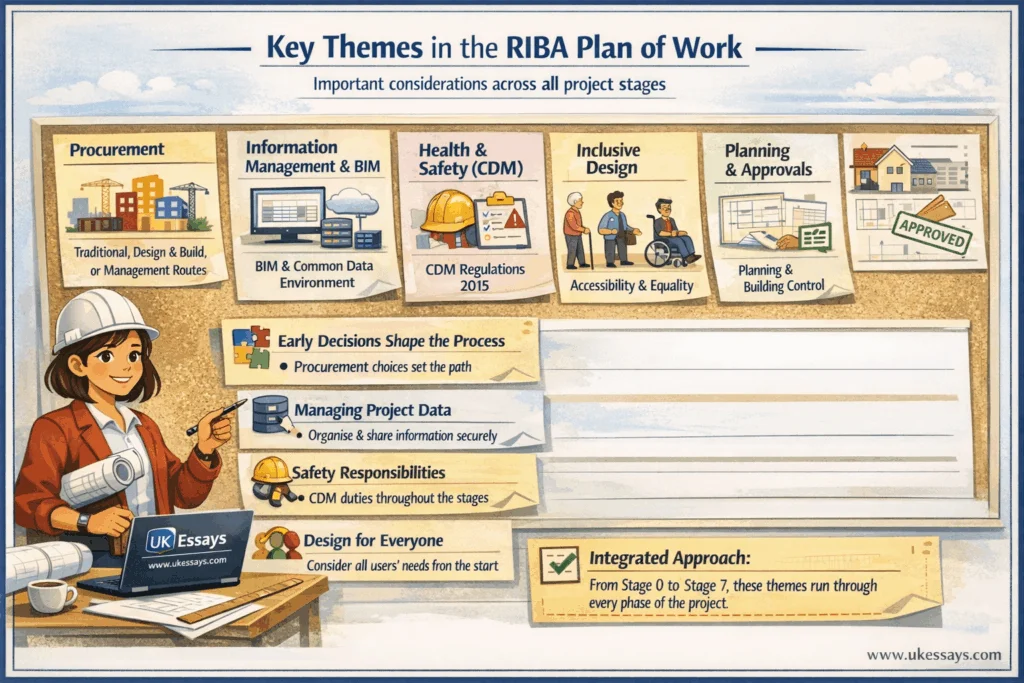
Several themes run across all stages of the Plan of Work and deserve specific attention.
Procurement
The RIBA Plan of Work is procurement-neutral, but the choice of procurement route fundamentally affects the sequence and responsibility for work at each stage. Under traditional procurement, the design team completes Stages 2–4 before the contractor is appointed. With design-and-build, the contractor may take responsibility from Stage 3 or Stage 4, completing the technical design. Under management contracting, works packages may be tendered progressively, with design and construction overlapping. Students should understand that the stage boundaries are not fixed walls but permeable membranes, shaped by procurement decisions made at Stages 0 and 1.
Information management and BIM
The UK BIM Framework, based on ISO 19650, defines how project information should be managed throughout the building lifecycle. The Plan of Work aligns with this framework, identifying information exchanges at each stage gateway. The concept of a common data environment (CDE) – a single source of truth for project information – is central to this approach. Each stage produces information at progressively greater levels of detail, from strategic models at Stage 1 to as-built models at Stage 6.
Health and safety
The Construction (Design and Management) Regulations 2015 (CDM 2015) impose duties on all parties, including the client, principal designer, principal contractor, designers, and contractors. The architect commonly acts as principal designer, with duties that begin at Stage 0 and extend through to the handover of the health and safety file at Stage 6. CDM duties map directly onto Plan of Work stages, and the 2020 Plan of Work explicitly references them.
Inclusive design
The Equality Act 2010 requires reasonable adjustments to be made for disabled people, and Part M of the Building Regulations sets minimum accessibility standards. However, genuinely inclusive design goes beyond regulatory compliance, considering the full spectrum of human diversity—age, disability, gender, culture, and neurodiversity. The Plan of Work encourages inclusive design considerations to be embedded from Stage 0 onwards, not treated as a compliance check at Stage 4.
Planning and regulatory approvals
Planning permission and building regulations approval are the two principal regulatory gateways in England and Wales (Scotland and Northern Ireland have separate but broadly analogous systems). With planning applications they are typically submitted at Stage 3, and building regulations applications at Stage 4, though the precise timing depends on project complexity and local authority requirements. For higher-risk buildings under the Building Safety Act 2022, a three-gateway regulatory regime applies, with the building safety regulator scrutinising applications at planning, before construction, and before occupation.
Practical considerations for students and practitioners
For students
Reference the correct edition. The 2020 Plan of Work is current. Referring to the 2013 or earlier editions without acknowledging the differences will weaken an essay or dissertation.
Understand the flexibility. The Plan of Work is not a rigid linear process. Design is iterative; stages overlap; information flows both forwards and backwards. Describing the Plan of Work as a simple sequential process demonstrates a superficial understanding.
Engage critically. The Plan of Work is a professional tool, not an academic theory. It has limitations: it is primarily oriented towards new-build projects (though it can be adapted for conservation and refurbishment); it reflects a UK-centric perspective; and it assumes a level of client sophistication that is not always present. Good academic work acknowledges these limitations.
Connect to theory. The Plan of Work can be situated within broader theoretical frameworks: systems theory, project management lifecycle models, design process theory (e.g., the work of Bryan Lawson or Nigel Cross on design thinking), and construction management literature.
For practitioners
Use the digital tool. RIBA provides an interactive digital Plan of Work tool that allows practices to customise the framework for specific projects, defining tasks, responsibilities, and information exchanges at each stage.
Align your appointment with the stages. Fee proposals and professional appointments should clearly reference Plan of Work stages, specifying the scope of service at each stage and the conditions for progressing between stages.
Invest in Stage 0 and Stage 1. The overwhelming evidence from post-project reviews is that insufficient investment in early-stage briefing and definition is the single greatest predictor of project failure (Egan, 1998).
Do not neglect Stage 7. Post-occupancy evaluation is both a professional obligation and a business opportunity. Practices that systematically learn from completed projects produce better buildings and stronger client relationships.
For further reading, Design Stage in Construction offers a closely related discussion of the design process in relation to the RIBA Plan of Work, while Process And Project Systems Construction Essay is useful for understanding how the RIBA framework connects to wider construction process management and procurement issues.
Need a model answer for your RIBA assignment?
An experienced specialist in your subject will write a complete model answer to your assignment on the RIBA stages.
Already written your draft? Get help with editing or get marking and feedback.
For those that enjoy having these topics explained this is a great video to watch.
References
- Blyth, A. and Worthington, J. (2010) Managing the brief for better design. 2nd edn. London: Routledge.
- Building Safety Act 2022, c.30. London: The Stationery Office. Available at: https://www.legislation.gov.uk/ukpga/2022/30/contents/enacted
- Construction Industry Council (CIC) (2015) Best practice guidance for building design and construction. London: CIC.
- de Wilde, P. (2014) ‘The gap between predicted and measured energy performance of buildings: a framework for investigation’, Automation in Construction, 41, pp. 40–49.
- Egan, J. (1998) Rethinking construction: report of the Construction Task Force. London: HMSO.
- Farmer, M. (2016) The Farmer Review of the UK construction labour model: modernise or die. London: Construction Leadership Council. Available at: https://www.constructionleadershipcouncil.co.uk/wp-content/uploads/2016/10/Farmer-Review.pdf
- Hackitt, J. (2018) Building a safer future: Independent Review of Building Regulations and Fire Safety – final report. Cm 9607. London: HMSO. Available at: https://www.gov.uk/government/publications/independent-review-of-building-regulations-and-fire-safety-final-report
- HM Government (2015) Construction (Design and Management) Regulations 2015. SI 2015/51. London: The Stationery Office. Available at: https://www.legislation.gov.uk/uksi/2015/51/contents/made
- Royal Institute of British Architects (RIBA) (2019) RIBA ethical standards. London: RIBA.
- Royal Institute of British Architects (RIBA) (2020) RIBA Plan of Work 2020 overview. London: RIBA. Available at: https://www.architecture.com/knowledge-and-resources/resources-landing-page/riba-plan-of-work
- Zumthor, P. (2006) Thinking architecture. 2nd edn. Basel: Birkhäuser.

Cite This Work
To export a reference to this article please select a referencing stye below: