
Belbin’s team roles guide
Info: 4165 words (17 pages) Study Guides
Published: 17 Mar 2026
Still struggling with the Belbin team role model? We can help! Our experienced team can assist with MBA level written research to produce clear, high-quality academic work. Find out more on our MBA Assignment Help page.
Effective teamwork is crucial in modern organisations and study environments, so understanding how different people contribute in teams is essential.
Meredith Belbin’s Team Roles model offers a framework for building balanced and successful teams by identifying distinct behavioural contributions (Belbin, 1981). This concept has academic roots in management research but remains highly practical. It is widely taught to students and used by professionals to improve team performance.
This guide provides a comprehensive overview of Belbin’s team roles. Including their historical development, definitions, real-world applications, and an examination of their benefits and limitations.
Historical background
Belbin developed his team role theory in the UK in the late 1960s and 1970s. He led a long-term study at Henley Management College observing numerous management teams in action (Belbin, 1981). Over nine years of research, Belbin and his colleagues analysed how different personalities and behaviours affected team performance.
One key finding was that the most successful teams have a diverse mix of behavioural roles, rather than a one-dimensional skill set (Belbin, 1981). In fact, Belbin noted that high-performing teams could demonstrate strengths in each of the distinct role types when needed. Thus aligning the right behaviours with the team’s objectives.
This research culminated in Belbin’s influential 1981 book Management Teams: Why They Succeed or Fail, which first outlined the team roles framework.
Originally, Belbin identified eight team roles in the 1970s research. Based on further observations and feedback, a ninth role was later added in the early 1990s to account for a type of specialist contributor (Belbin, 1993).
Some of the role labels were also refined – for example, the “Chairman” role was re-termed “Co-ordinator” – but the core concept remained the same.
By the mid-1990s, the Belbin team role model had gained international prominence as a tool for understanding team dynamics. Today it is considered a foundational theory in team management and has been incorporated into countless training programmes and academic curricula.
Belbin’s framework has endured for decades due to its intuitive insight. That teams work best when they are composed of individuals who complement each other’s strengths and weaknesses.
Understanding the Belbin team role model
Core principles of the Belbin team role model
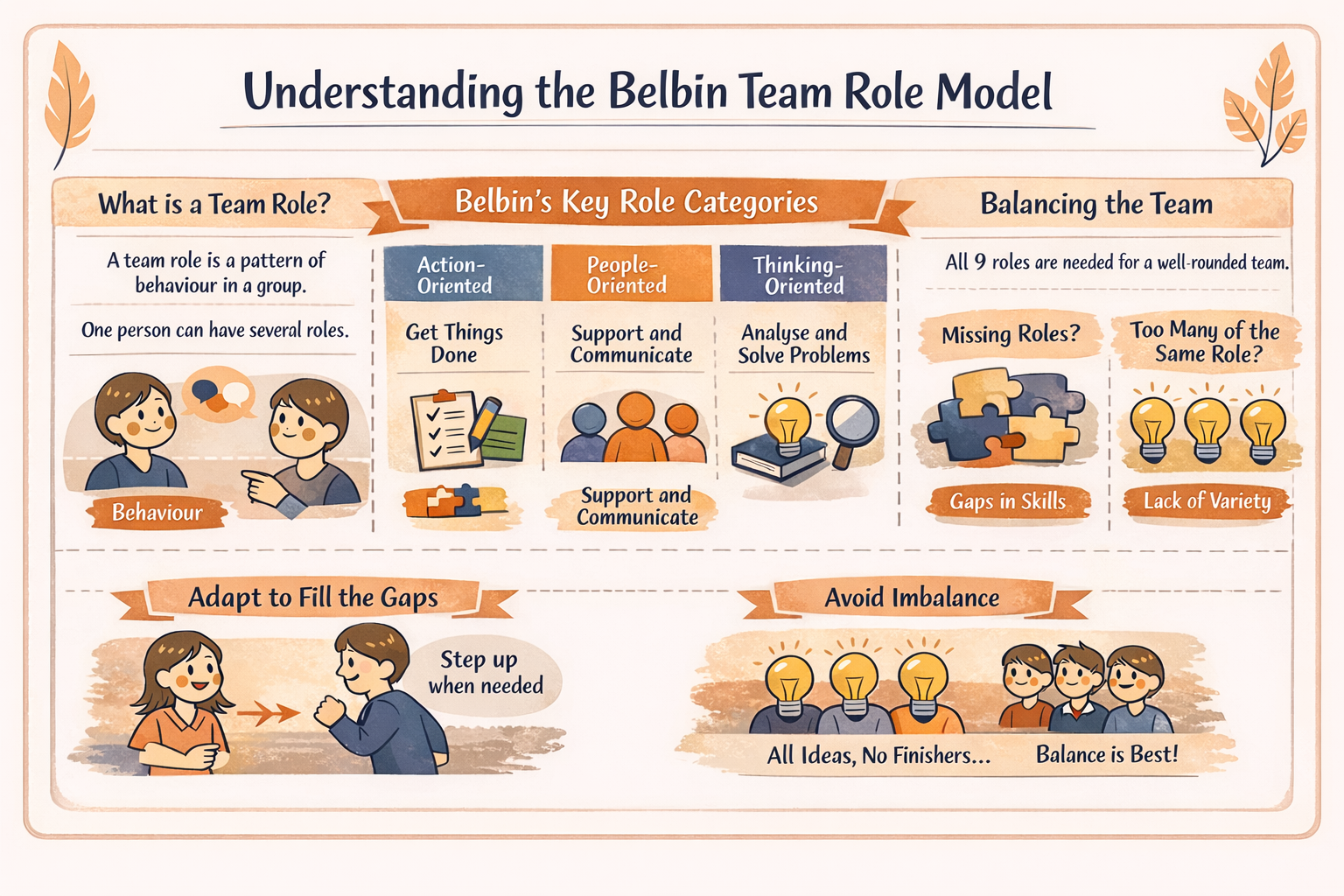
What is a “team role”? Belbin defines a team role as “a tendency to behave, contribute and interrelate with others in a particular way” within a team (Belbin, 1993). In other words, a team role is a cluster of behavioural traits and interpersonal styles. These styles blend together to fulfill a particular function in helping a team progress.
Importantly, Belbin’s roles are not fixed personality types but rather patterns of behaviour. An individual can adopt different roles over time or in different teams, and most people have a mix of preferred roles.
Belbin observed that each person typically has two or three roles in which they are naturally strong. Along with other roles that feel less comfortable. This means a team of four or five people can still cover all nine roles if members each play multiple roles (Belbin, 2010).
The roles are also context-dependent: a person might step up in an unfilled role if the team requires it.
Role categories and team balance
Belbin’s model groups the nine roles into three categories based on their orientation: action-oriented, people-oriented, and thinking-oriented roles (Belbin, 1993).
Each role has typical “allowable strengths” (the positive characteristics they supply to the team) and “allowable weaknesses” (areas where that role may have shortcomings that need management).
Belbin emphasizes that none of the roles is inherently superior to the others. All nine are needed in balance for a well-rounded team. An ideal team will have a healthy representation of all the roles (or the behaviours associated with them). Allowing the team can handle a variety of challenges (Cambridge IfM, n.d.). In practice, real teams may have gaps or overlaps in roles; recognising these gaps allows teams to adjust.
For example, if a team lacks a certain role, a member can consciously adopt that behaviour when necessary, or the team can bring in someone new to fill the void. Conversely, if too many team members have the same preferred role, the team might become unbalanced. For instance, a team of all ideas people with no finishers may generate great concepts but struggle to implement them.
Identifying roles through the Belbin inventory
To help individuals and teams identify their Belbin roles, the Team Role Self-Perception Inventory (BTRSPI) was developed (Belbin, 1981).
This is a questionnaire in which team members self-assess how they typically behave in teamwork scenarios. The inventory can be supplemented by observer assessments. Where colleagues also provide feedback on someone’s behaviour in a team (Cambridge IfM, n.d.). The result is a profile showing an individual’s top role contributions and lesser-used roles.
Belbin’s assessment is behavioural (not psychometric). Meaning it measures how people prefer to act in a team rather than measuring inherent psychological traits (Belbin, 2010).
The feedback is intended to be constructive. Individuals gain awareness of their natural strengths in a team and also which roles they might need to “borrow” from others. Belbin stressed that the tool should be used to facilitate discussion and development, not to pigeon-hole people permanently into one role.
The nine team roles
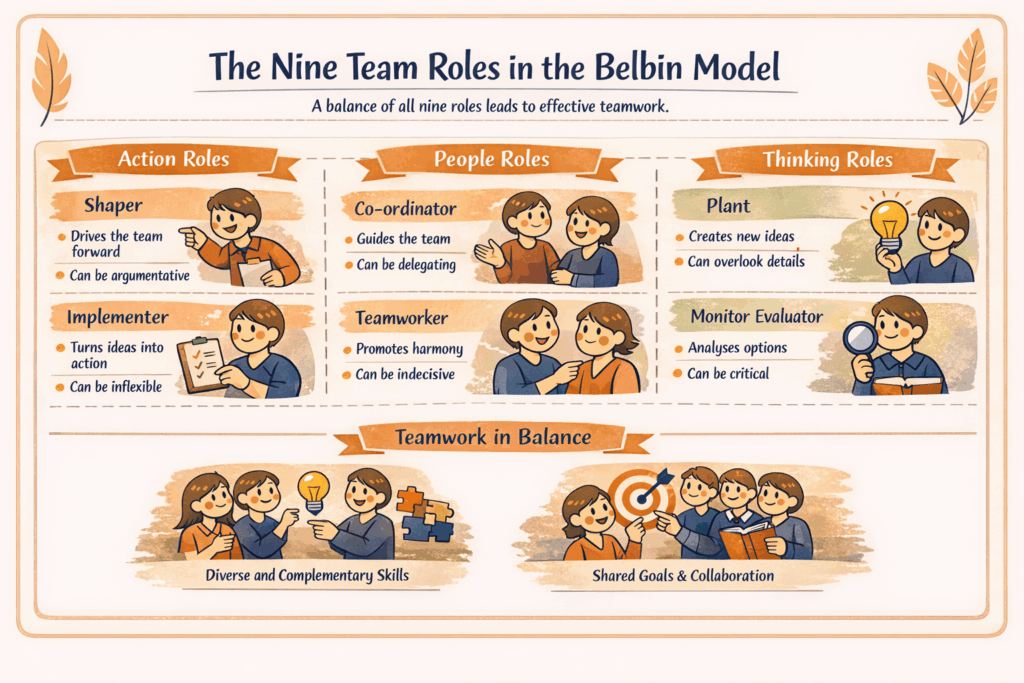
Belbin’s nine team roles can be remembered as a set of archetypes found in most teams. They are often listed in three families – action, people, and thinking roles – as follows:
Action-oriented roles
Shaper: The dynamic driver who challenges the team to move ahead. Shapers are outgoing and enjoy pressure; they push others to achieve and keep the group focused on goals. However, a Shaper may become argumentative or hurt others’ feelings in their zeal to win (Belbin, 2010).
Implementer: The practical organiser who turns ideas into concrete actions. Implementers are disciplined, efficient and reliable, diligently planning and carrying out tasks. However, they can be somewhat inflexible and slow to embrace new possibilities if it means deviating from their plan (Belbin, 2010).
Completer-Finisher: The perfectionist who diligently checks details and polishes the work at the end. Completer-Finishers are conscientious and anxious to get things right; they catch errors and ensure high-quality output. However, they may worry excessively and have a hard time delegating, sometimes bogging down in pursuit of perfection (Belbin, 2010).
People-oriented roles
Co-ordinator: The chairperson of the team who clarifies goals, allocates tasks and orchestrates the group’s efforts. Co-ordinators are confident, mature and good at seeing others’ talents. They bring out the best in the team by delegating effectively.
On the downside, a Co-ordinator can be seen as overly controlling or may offload their own share of work after assigning tasks (Belbin, 2010).
Teamworker: The supportive diplomat who fosters team cohesion. Teamworkers are co-operative, perceptive listeners who help with conflict resolution and encourage harmony. They are versatile and willing to help wherever needed, prioritising the team’s needs above individual ego.
However, Teamworkers may be indecisive in crunch situations and tend to avoid confrontation. Occasionally at the expense of swift decision-making (Belbin, 2010).
Resource Investigator: The enthusiastic networker who explores outside opportunities and connections. Resource Investigators are curious, outgoing communicators. They love to brainstorm, scout for information and build contacts that can benefit the team.
However, they might become over-optimistic, and their initial enthusiasm can fade. A Resource Investigator may drop follow-up tasks once the novelty wears off (Belbin, 2010).
Thinking-oriented roles
Key thinking-oriented roles
Plant: The creative innovator who comes up with original ideas and solves difficult problems. Plants tend to be imaginative and unorthodox thinkers; they thrive when given space to think freely and generate proposals.
However, a strong Plant may ignore practical details or fail to communicate their vision clearly. They can be somewhat absent-minded or dismissive of constraints while pursuing ingenious solutions (Belbin, 2010).
Monitor Evaluator: The sober, analytical strategist who carefully evaluates options and spots pitfalls. Monitor Evaluators are even-tempered and objective; they provide a logical eye and make impartial, evidence-based judgments on ideas.
On the other hand, they lack drive at times. A Monitor Evaluator can be slow to decide because they prefer to analyse thoroughly, and they might appear overly critical or pessimistic when pointing out flaws (Belbin, 2010).
Specialist: The dedicated expert who contributes in-depth knowledge of a key area. Specialists are single-minded and passionate about their field. They ensure the team has the technical or subject matter expertise required for the task.
However, they by definition have a narrow focus – a Specialist tends to concentrate on their specific domain and may not concern themselves with broader team issues. They can also overload the team with detailed information if not kept in check (Belbin, 2010).
Importance of balance and interdependence
Each of these nine roles is distinct, yet they are all interdependent. Belbin’s central thesis is that teams need a balance of all these contributions to cover every angle of a project (Belbin, 1981).
For example, creative ideas from Plants and Resource Investigators must be evaluated by Monitor Evaluators. Also organised into plans by Implementers or Co-ordinators, driven into action by Shapers, supported by Team workers, checked by Completer-Finishers, and informed by Specialists when expertise is needed. If any role is missing, the team may experience a weakness in that area.
Conversely, if too many people try to play the same role, there can be internal competition or neglect of other functions.
Awareness of Belbin roles helps team members understand why certain behaviours (which might be seen as “weaknesses” in isolation) can actually be allowable trade-offs for an individual’s strengths in their role.
It also encourages appreciation of complementary skills – for instance, a creative but disorganised Plant can succeed if paired with a conscientious Implementer, and vice versa.
Real-world applications of Belbin’s roles
Belbin’s team role framework has been applied widely in business management, education, and professional development. Over the past few decades it has become one of the most popular tools for team building worldwide (Aritzeta et al., 2007).
Benefits for team performance and collaboration
Use in organisations
Organisations ranging from small firms to large multinationals have used Belbin’s model to compose effective teams, improve teamwork, and resolve team conflicts. In fact, many high-profile companies have incorporated Belbin’s roles into their management training.
Studies indicate that numerous FTSE-100 corporations and government agencies have used the Belbin approach to enhance team performance (Aritzeta et al., 2007).
The Belbin model and its accompanying reports are available in over a dozen languages and utilised in more than 100 countries, underscoring its global reach (Aritzeta et al., 2007).
In business and management practice, Belbin’s roles are used as a common language to discuss people’s behavioural contributions.
For example, when assembling a project team, a manager might ensure that they have at least one good Shaper to drive progress. As well as a couple of strong Implementers to execute plans, and perhaps a Monitor Evaluator to provide critical oversight.
Teams in industry often undertake Belbin workshops or complete the Belbin inventory to identify the role strengths present or missing among members. This awareness can be very pragmatic: if a team finds it has no natural Completer-Finisher, they might agree on methods to double-check work quality. Moreover assign someone to consciously take on that responsibility.
Belbin roles have also proven useful in leadership development and coaching. By understanding their own team role profile, managers and team leaders can adapt their style or surround themselves with others who fill their weak spots.
The model is not used for hiring in a discriminatory way (e.g., one would not refuse a candidate solely for being a Plant versus a Shaper), but it can inform questions about how a new hire might fit into a team’s mix.
Practical impact in the workplace
Several real-world case studies highlight Belbin’s practical impact.
A notable example is the global company Alibaba. Which adopted Belbin’s Team Roles across its organisation to improve collaboration (Belbin, n.d.). Alibaba used Belbin workshops for various management groups. They found that having a “common language” of team roles helped employees better understand each other’s perspectives and work more cohesively.
Different departments mapped out their team role distributions, enabling them to tackle gaps and reduce misunderstandings. For instance, recognising why a team of all Shapers was experiencing conflict, or why a department with many Teamworkers but no Shaper might struggle to make bold decisions.
Many other organisations have reported similar benefits. Teams in sectors from finance to healthcare (including units of the UK National Health Service) have used Belbin profiles to improve team composition and communication.
Belbin’s own company reports that its methodologies have been embraced by organisations such as the United Nations and the World Bank as part of their team development initiatives.
These examples demonstrate that the Belbin roles are not just theory – they are actively applied to solve everyday teamwork challenges. Such as improving meetings, allocating work more effectively, and integrating diverse personalities into a functional whole.
Use in education and training
In education and professional training, Belbin’s framework is also widely applied.
Business schools and universities often use Belbin’s Team Role Inventory with student teams, particularly in MBA or management courses where group projects are common. The goal is to raise students’ self-awareness and to teach them how to form balanced teams.
Studies in higher education have tested Belbin’s idea of balanced team roles. For instance, forming student project teams that collectively cover all nine roles, versus teams that are unbalanced, and then comparing their performance.
The findings have been mixed but illuminating. Some research in collaborative learning settings suggests that balanced-role teams can achieve better teamwork quality and initial performance (Meslec and Curşeu, 2015). Students in balanced teams often report more satisfaction because each member has a clear niche and the workload is distributed according to strengths.
However, other studies indicate that simply having all roles present does not guarantee higher outcomes in the long term. Factors like team leadership and skills still matter, and too rigid an insistence on role balance can even be counterproductive if it ignores personal chemistry (Flores Ureba et al., 2022).
Nonetheless, educators have found Belbin’s model a valuable pedagogical tool. It gives students a vocabulary to discuss team dynamics and reflect on their contributions. E.g., “I tended to act as a Monitor Evaluator in our group, which was helpful for analysis, but I might have slowed us down by over-criticising ideas”.
By learning about team roles, future managers gain insight into how to build and manage teams in their careers. Likewise, many professional qualification programs (for example, leadership certifications and project management courses) include Belbin’s team roles to teach the importance of diversity in teamwork.
Benefits and limitations of the model
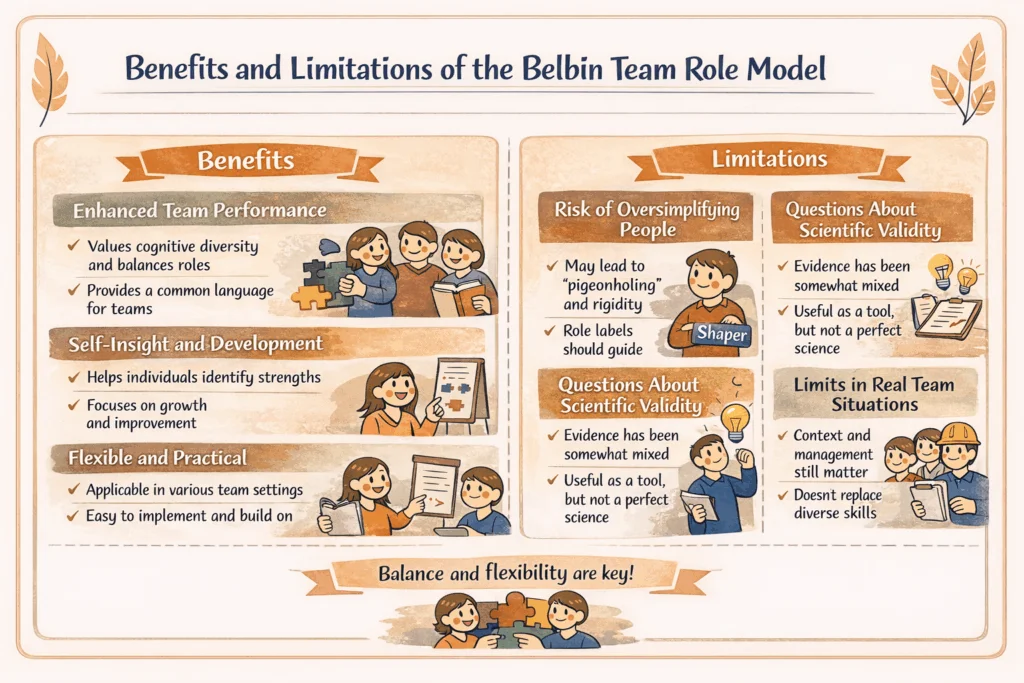
Belbin’s Team Roles have endured in popularity because they offer several clear benefits for team development.
First, the model underscores the value of cognitive diversity. It shows that a team needs a mixture of thinkers, doers, leaders, supporters and experts. This often helps teams move beyond personal differences and appreciate each member’s contributions.
For instance, rather than viewing the meticulous detail-checker as “nitpicky” or the big-vision brainstormer as “impractical”, the team learns to recognise these as Completer-Finisher and Plant contributions, each valuable in context. In this way Belbin’s framework can foster mutual understanding and tolerance in teams (Cambridge IfM, n.d.).
Furthermore, using the team roles gives teams a common language to discuss and negotiate how they will work together. It provides a neutral, constructive way to address team composition. For example, a team might agree “We are light on Monitor Evaluators, so let’s all try to be extra careful in our decision-making,”. Conversely a project leader might explain “I’ve assigned Alice to this task because she’s an excellent Implementer and will get the job done efficiently.”
Many organisations report that this shared terminology makes it easier to resolve conflict. As differences are reframed as different role styles, not personal flaws and to plug performance gaps by encouraging someone to step into an unfilled role.
Indeed, research has found that teams balanced in Belbin roles tend to have fewer blind spots and can perform robustly across a range of activities (Aritzeta et al., 2007).
Benefits for individual development and practical application
Individuals also benefit from the Belbin approach. Completing a Belbin report can yield actionable self-insights.
People often discover non-intuitive strengths. For example, a quiet team member might learn that others see them as a good Teamworker who fosters collaboration. Alternatively, a very creative person might realise they could improve their effectiveness by partnering with a strong Implementer.
By identifying one’s top roles, a person can aim to maximize their strengths in those roles while being mindful of their weaknesses.
Belbin’s notion of “allowable weaknesses” is particularly useful. It encourages individuals to acknowledge their own shortcomings without stigma, as natural trade-offs to their strengths. This sets the stage for personal development (one can work on mitigating weaknesses) and smart team design (pairing people with complementary profiles).
Additionally, the Belbin framework is highly flexible. It applies to any kind of team from corporate boards to volunteer committees and can be used alongside other team development methods. It does not require expensive or complex intervention; a simple workshop or discussion can introduce the concepts with immediate practical payoff.
Limitations and criticisms of the model
However, like any model, Belbin’s Team Roles have limitations and have faced critiques.
Risk of oversimplifying people
One common criticism is that the roles can lead to oversimplification and “pigeon-holing” of individuals if misused (Furnham et al., 1993). Human behaviour is rich and cannot be perfectly divided into nine boxes. Real people do not always fit neatly into a single role, and their behaviour can change depending on context.
If a team becomes too fixated on labelling members (“you are the Shaper, you are the Monitor Evaluator, and that’s that”), there is a risk of self-fulfilling prophecies or rigidity.
Belbin’s intent was that people rotate and share roles as needed, so it’s important teams use the model as a starting point for dialogue rather than a strict classification system.
Questions about scientific validity
The model has also been questioned on scientific grounds. Researchers have conducted numerous studies to test the validity of the Belbin roles and the accuracy of the Self-Perception Inventory.
The evidence has been somewhat mixed. Some studies have found overlaps between certain roles. For example, Shaper and Co-ordinator might correlate, suggesting those scales are not entirely distinct, and early evaluations by psychologists raised concerns about the inventory’s reliability (Furnham et al., 1993).
On the other hand, a comprehensive review of 43 studies concluded that the team role model shows adequate validity overall. The roles do correspond to meaningful behavioural patterns, even if the psychometric precision is not perfect (Aritzeta et al., 2007).
In practice, the inventory’s imperfections are not a huge problem if users treat the results as a discussion tool rather than a definitive test. Belbin himself noted that his inventory was designed for practical usefulness in team building, not as a clinical personality test (Belbin, 2010).
Limits in real team situations
Another limitation is that having all nine roles covered in a team does not automatically guarantee success. Context and management still matter.
For example, if a team’s task is very routine, it might not need a Plant’s creativity as much, or if the task is highly technical, not having a Specialist could be a serious shortfall. Balance is beneficial, but it should align with the team’s purpose.
Additionally, teams can sometimes over-rely on strong individuals in given roles. For example, always expecting the one Co-ordinator to lead, rather than developing those skills in other members. Good teams are dynamic and allow members to grow into roles over time (Cambridge IfM, n.d.).
Finally, it’s worth noting that Belbin’s model mainly addresses behavioural diversity. Yet real teams also need diversity in skills, background, and demographic perspectives.
Belbin roles should therefore be considered as one aspect of team design among others. They complement, rather than replace. Other frameworks for instance, the model can be used alongside personality assessments or technical skill audits to get a full picture of team composition).
In summary, while the Belbin team roles concept is a powerful and enduring tool, it should be applied with nuance. Used wisely, it offers insightful guidance; used uncritically, it could oversimplify complex team dynamics.
Conclusion
Belbin’s Team Roles model has stood the test of time as a seminal approach to understanding team behaviour. From its origins in scholarly research to its widespread use in classrooms and boardrooms, the framework has proven to be both theoretically robust and pragmatically useful.
It teaches that effective teamwork is not just about recruiting talented individuals, but about achieving the right balance of complementary roles. A team thrives when its members each contribute in ways that play to their strengths. As well as when they appreciate the different contributions of their colleagues.
Belbin’s great contribution was to identify and articulate those contributions in a memorable way. Terms like “Plant”, “Shaper”, or “Teamworker” have entered the vocabulary of team development across the globe.
For students of management, Belbin’s roles provide a practical lens to analyse team case studies and reflect on personal team experiences. For professionals, the roles serve as a checklist for building well-rounded teams and a toolkit for diagnosing team issues.
The model’s longevity in both domains is a testament to its clarity and applicability. It is straightforward enough to be grasped by a new team in a one-hour workshop. Yet nuanced enough to warrant ongoing reflection and refinement.
Research into Belbin’s theory continues to evolve. For example, examining how role balance affects performance in different settings, and the model has been updated and extended by Meredith Belbin and others over the years. But its core message remains remarkably consistent and resonant. Diversity in team roles is the key to unlocking a team’s full potential.
Final thoughts
In conclusion, Belbin’s team roles offer a valuable framework for anyone looking to understand or improve team dynamics. By recognising the distinct roles needed for team success – and by being mindful of their interplay, strengths, and weaknesses – teams can become more than the sum of their parts.
This comprehensive guide has explored the essence of each role, the evidence behind the model, and its practical implications. Armed with this knowledge, both students and practitioners can more confidently analyse teams and guide them towards higher performance.
In the words of Belbin himself, “Simply putting together a number of people and expecting them to work as a team is not enough” – it is the right combination of roles and the thoughtful management of their contributions that truly makes a team excel (Belbin, 2010).
Further reading
While Belbin’s Team Role Model offers valuable insight into how individuals contribute to teamwork, other frameworks also help explain how teams function and develop. Readers interested in exploring this topic further may find it useful to look at Tuckman’s Stages of Group Development, which examines how teams evolve over time, and Hofstede’s Cultural Dimensions Theory, which explains how cultural differences can influence teamwork and leadership styles.
Still struggling with the Belbin team role model? We can help! Our experienced team can assist with MBA level written research to produce clear, high-quality academic work. Find out more on our MBA Assignment Help page.
For those that prefer to listen to explanations as well as read them, Dr Hayley Stainton gives a fun presentation in the video below.
References
- Aritzeta, A., Swailes, S. and Senior, B. (2007) ‘Belbin’s Team Role Model: Development, Validity and Applications for Team Building’, Journal of Management Studies, 44(1), pp. 96–118. DOI: 10.1111/j.1467-6486.2007.00666.x.
- Belbin, R. M. (1981) Management Teams: Why They Succeed or Fail. London: Heinemann.
- Belbin, R. M. (1993) Team Roles at Work. Oxford: Butterworth-Heinemann.
- Belbin, R. M. (2010) Management Teams: Why They Succeed or Fail (3rd ed.). Oxford: Routledge.
- Belbin (n.d.) ‘Co-operation with Belbin at Alibaba’ (Case Study) – Belbin Resources. Available at: https://waww.belbin.com/resources/case-studies/using-belbin-in-alibaba (Accessed 09 October 2025).
- Cambridge IfM (n.d.) ‘Belbin’s team roles’. Institute for Manufacturing, University of Cambridge. Available at: https://www.ifm.eng.cam.ac.uk/research/dmg/tools-and-techniques/belbins-team-roles/ (Accessed 05 October 2025).
- Flores Ureba, S., Simón de Blas, C., Borrás-Gené, O. and Macías-Guillén, A. (2022) ‘Analyzing the influence of Belbin’s roles on the quality of collaborative learning for the study of Business Fundamentals’, Education Sciences, 12(9), p. 594. DOI: 10.3390/educsci12090594.
- Furnham, A., Steele, H. and Pendleton, D. (1993) ‘A psychometric assessment of the Belbin Team-Role Self-Perception Inventory’, Journal of Occupational and Organizational Psychology, 66(3), pp. 245–257.
- Meslec, N. and Curşeu, P. L. (2015) ‘Are balanced groups better? Belbin roles in collaborative learning groups’, Learning and Individual Differences, 39, pp. 81–88. DOI: 10.1016/j.lindif.2015.03.020.

Cite This Work
To export a reference to this article please select a referencing stye below: