
PhD funding in the UK: scholarships, grants and beyond
Info: 7521 words (30 pages) Study Guides
Published: 15 Apr 2026

UK Essays writing support
Writing a research proposal for a PhD funding application?
We’ll write a complete model research proposal based on your research idea and funding application requirements.
Send us your research idea and, if you wish, any university guidance. An experienced specialist in your subject will write your model proposal from scratch.
All our writers hold at least a 2:1 degree from a reputable university. Most hold a master’s degree or PhD, and/or have teaching experience.
Securing funding is often the biggest hurdle for PhD aspirants in the UK. Undertaking a doctorate is a significant financial commitment, and many talented students worry “how will I pay for this?”
Fortunately, the funding landscape for UK PhDs is diverse. This in-depth guide maps out every possible funding source – from well-known scholarships to creative, lesser-known routes – and offers actionable advice to increase your chances of success.
Prospective doctoral students will find reassurance that generous funding is available, and learn how to piece together a viable financial plan for their PhD journey.
Understanding the PhD funding landscape
In the UK, PhD funding comes from a patchwork of sources. Some students secure a single fully-funded award that covers all fees and living costs, but many rely on multiple partial funding streams.
You might receive a scholarship covering tuition and use savings or a loan for living expenses, or combine several smaller grants. Therefore, it is important to understand the broad categories of funding and how they can intersect.
Types of PhD funding
- Fully-funded: A full studentship pays your tuition, provides a stipend for living costs, and often covers research expenses (FindAPhD, 2025). This is the ideal scenario, but highly competitive.
- Partially-funded: You have some funding – for example, a tuition waiver or a living allowance. However, you must top up with other sources such as grants, part-time work or loans to meet the shortfall (FindAPhD, 2025).
- Self-funded: You receive no significant awards, and thus finance the PhD yourself through personal savings, family support, loans, and income from work (FindAPhD, 2025). This route requires careful planning and is usually a last resort when other funding is not secured.
Combining different sources of support
Most students begin by seeking full funding, but flexibility is key. It’s not uncommon to start a PhD partially-funded or self-funded and then win additional funding later. Indeed, you might stitch together several smaller awards into a “portfolio” that, in total, sustains your PhD.
Major sources of PhD funding in the UK include research councils (UKRI), university scholarships, student finance loans, teaching assistantships, charitable grants, and industry sponsorship. Aspiring PhD students often combine multiple avenues to cover tuition fees and living costs. For example, a student might receive a partial university scholarship and then use a loan and a small charity grant to make up the difference.
Main funding categories:
Key funding sources for PhDs can be grouped into several overlapping categories (FindAPhD, 2025):
- UK Research Councils and government: The UK’s seven research councils (united under UK Research and Innovation, UKRI) provide thousands of doctoral studentships each year. These are prestigious and typically cover full costs, but are highly competitive. The government also offers doctoral student loans as financial support.
- University scholarships and studentships: Many universities run their own funding competitions – from full doctoral scholarships to smaller bursaries or fee waivers. Departments and colleges may have endowments or alumni-funded awards for top candidates.
- Charities and trusts: Independent foundations, charities and trusts (especially in health, science, or education) fund doctoral research aligned with their mission. Some offer full grants, while others provide partial assistance to supplement other funding.
- Professional bodies and industry: In certain fields, professional institutes or companies sponsor PhD research. Collaborations between academia and industry (such as industrial CASE studentships) allow businesses to co-fund a PhD that benefits their R&D. Moreover, if you are employed in a relevant sector, your employer might sponsor your doctoral study as professional development.
- Personal funding and others: When formal funding falls short, students may resort to personal resources. This can include the national doctoral loan, part-time work or teaching, and even creative approaches like crowdfunding campaigns.
Each of these avenues will be explored in detail in the sections below. By mapping out every option and considering combinations, you can assemble a funding solution tailored to your circumstances.
Research council studentships (UKRI)
The most substantial PhD funding in the UK comes from UKRI research council studentships. UKRI (UK Research and Innovation) is an umbrella body for several research councils (MRC, EPSRC, AHRC, etc.), each supporting different academic disciplines. These studentships – often called Doctoral Training Partnerships (DTPs) or Centre for Doctoral Training (CDT) scholarships – typically provide:
- Tuition fees: Full coverage of PhD tuition (at least the home student fee level, ~£5,000 per year) (UKRI, 2025).
- Stipend for living costs: A tax-free maintenance allowance. For example, the UKRI minimum stipend for 2025/26 is £20,780 per year for living expenses (UKRI, 2025). London-based students or certain fields may receive a higher rate or top-ups from the host university.
- Research support: Many awards include additional funding for training, conference travel, or equipment, recognising that doctoral research incurs extra costs (UKRI, 2025).
These studentships are generous – a fully-funded package that frees you from financial burden and allows focus on your research. Importantly, the stipend does not need to be repaid. Securing such funding is therefore highly competitive. UKRI funds roughly 20% of all UK PhD students (UKRI, 2025), meaning the majority of doctoral candidates must find alternative support. However, if you are eligible and your project fits, research council funding is a gold standard to pursue.
Who is eligible?
Traditionally, UKRI studentships were restricted to UK/Home students or those meeting residency requirements. In recent years, UKRI opened some scholarships to international students as well, though usually only covering tuition at the domestic rate (UKRI, 2025). Academic excellence is essential: you generally need a strong first degree (at least a 2:1 or equivalent) and often a relevant Master’s qualification. The application may require a research proposal and is usually made through the university or a doctoral training centre, rather than directly to UKRI.
When and how to apply?
Application timelines are typically early. For a PhD starting in the autumn (October), many research council doctoral training programs accept applications in the preceding winter – often with deadlines around December to February (Prospects, 2025a).
Some universities automatically consider all admitted PhD applicants for any available studentships, but many require a separate funding application. It is crucial to check specific deadlines for the programmes or doctoral training partnerships in your field. Start inquiries early in the academic year (around October) for entry the following year.
To maximise your chances:
- Find the right fit: Identify the doctoral training program or funding call that matches your research area. Each council (AHRC, ESRC, etc.) has priority themes and strategic areas of investment.
- Draft a strong research proposal: Even if you apply to a pre-defined project, you may need to articulate your approach and its significance. Show how your work aligns with the funder’s goals and contributes original knowledge.
- Get supervisor support: Prospective supervisors often have insights into available studentships and can guide your proposal. They may even nominate strong candidates for funding. Engage with a potential supervisor early; their endorsement can carry weight.
- Polish the application: Treat it like a job application. Follow all formatting guidelines, and have mentors or peers review your research proposal and personal statement. As one careers adviser suggests, have someone proofread your application and ensure your referees will give glowing recommendations (Prospects, 2025a).
Research council studentships represent the ideal funding scenario for many, providing stability and status. Because of the competition, it is wise to simultaneously explore other options below – but a well-prepared application to a UKRI program is certainly worth the effort.
University scholarships and grants
Almost every UK university offers its own array of PhD funding opportunities. These can range from full scholarships covering fees and stipend, to partial awards that reduce the financial load. Unlike UKRI studentships (which often come via consortia or national competitions), university awards are institution-specific and typically tied to attracting excellent students to that university.

Types of university funding:
University-wide scholarships:
These are flagship awards open to students of any discipline (or broad groups of disciplines) at the institution. For example, the University of Oxford’s Clarendon Scholarships or the University of Cambridge’s Vice-Chancellor’s Awards offer full funding to a number of top PhD candidates each year. Such scholarships are merit-based, considering academic achievements and research potential.
Departmental or faculty studentships:
Specific departments may have funding for certain research areas or strategic projects. A science faculty might fund PhDs in sustainability research, or a history department might have a scholarship endowed by a benefactor for medieval studies. These awards often cover fees and sometimes a stipend, typically for 3–3.5 years.
Fee waivers and bursaries:
Some universities offer partial support in the form of fee waivers (e.g. not charging tuition) or small bursaries to assist with living costs. These might be offered to runners-up for bigger scholarships or to broaden access (such as discounts for the university’s own graduates continuing to PhD).
Graduate teaching assistantships (GTAs):
A number of institutions offer funding packages that combine work and study. In return for a tuition waiver and a salary or stipend, you undertake teaching duties (for example, leading undergraduate seminars or labs). The workload is usually part-time (perhaps 6–10 hours per week of teaching or preparation). GTAs provide valuable experience and an income; however, balancing teaching responsibilities alongside PhD research requires good time management. It is important to ensure the teaching load is reasonable and does not significantly prolong your PhD.
Performance and access scholarships:
As part of widening participation, some universities have scholarships for under-represented groups. There are awards earmarked for students from specific nationalities, for refugees, or for those who excel in areas like sports or music alongside academics (British Council, 2024). While more common at undergraduate level, a few exist for postgraduates – for example, some institutions offer PhD scholarships for BAME students or others aimed at improving diversity in research.
Universities usually publicise their funding opportunities on their postgraduate admissions or funding web pages. Application processes vary: in some cases, when you apply for the PhD place you are automatically considered for relevant funding (especially common for departmental studentships tied to an offer). In other cases, you must submit a separate scholarship application or indicate your interest in funding on the admission form. Pay close attention to instructions and deadlines – many internal scholarship competitions align with those of research councils (December–February), but some universities run later rounds or have multiple cycles.
The criteria for university scholarships often mirror those of external funders: academic merit, research proposal quality, fit with institutional research priorities, and sometimes an interview. If you are serious about a particular university, reach out to its admissions or graduate funding office to ask about available funding. They can clarify the range of awards (some might be obscure or newly established).
It is also wise to cast a wide net: apply to multiple universities and funding opportunities. Unlike undergrad, PhD admissions are less centralised – you could potentially secure an offer (and funding) from one university while another might not offer funding. Having options puts you in a stronger position.
Remember that university funding can be combined with other sources. For example, a partial departmental bursary could be supplemented by an external charity grant or the doctoral loan. Many UK universities explicitly encourage funded students to seek top-up grants for research costs or conference travel. As long as there is no conflict (check any conditions), stacking scholarships is a sensible strategy to reach full coverage.
Charities, foundations and trusts
Beyond universities and government bodies, charitable organisations and trusts are significant yet sometimes overlooked sources of PhD funding in the UK. Hundreds of independent charities – from large research foundations to small philanthropic trusts – offer grants that can support doctoral researchers. Tapping into this sector requires initiative, but it can pay off, especially for students whose research aligns with specific causes.
Major research charities often fund PhDs in their mission areas. For example:
- Wellcome Trust – a large biomedical research charity – has competitive PhD programmes and fellowships in health and life sciences. These typically provide full funding (fees and stipend) for outstanding proposals in biomedical or social sciences related to health.
- Cancer Research UK, British Heart Foundation (BHF), Alzheimer’s Society, Diabetes UK, and others – these medical charities fund doctoral studentships to advance research into prevention and treatment of diseases (Prospects, 2025a). Such studentships are usually hosted at universities (the charity provides a grant to the academic supervisor or department to support a PhD student working on a specific project).
- The Leverhulme Trust – an educational foundation – runs schemes like the Leverhulme Doctoral Scholarships, where it awards funding to universities to support PhD students in particular themes. It also offers Study Abroad Studentships for doctoral researchers needing to spend time overseas, among other grants.
- Specialist charities and trusts – Numerous smaller bodies support education or research. For example, Action Medical Research funds some PhDs in medical science, and the British Federation of Women Graduates (BFWG) gives awards to female doctoral students of any discipline (Prospects, 2025a). There are also trusts dedicated to supporting students from certain regions, backgrounds, or working on particular topics (heritage, ecology, social justice, etc.).
Applying for charity funding often means looking for opportunities beyond the usual university admissions cycle. Some charity grants are advertised on sites like FindAPhD or Jobs.ac.uk, but many are only findable via the charity’s website or directories of grants. A great resource is the annual Grants Register or databases like ResearchProfessional and Postgraduate Studentships – these can help identify obscure trusts by filtering for your field or personal circumstances.
Characteristics of charity funding:
- Competitive but focused: While competition exists, the applicant pool is smaller and more specific than broad national schemes. If your research topic exactly fits a charity’s aim (say, a conservation trust supporting wildlife ecology research), you may have a strong chance.
- Partial funding: Many trust grants are relatively small (e.g. £500 to £5,000) intended to supplement other funding. However, there are some larger awards (Leverhulme, Wellcome, etc., can fully fund). Think creatively – someone might combine a university fee waiver, a £10,000 charity grant and a loan for living costs to piece together their budget.
- Eligibility criteria: Charities often set specific requirements. Some target students who have a certain personal background or belong to particular regions or demographics. For instance, one educational trust might only fund students under 30 who went to school in a certain county. Another charity might restrict funding to descendants of people in a particular trade. Read the fine print to avoid wasted effort, and don’t hesitate to contact the trust to clarify if you are eligible.
Applying to charities usually involves a grant proposal or application form, often simpler than academic proposals. You’ll need to explain your research in lay terms, articulate how it aligns with the charity’s objectives, and provide a budget or funding plan. Charities may also require reference letters or evidence of academic merit. It is crucial to clearly convey the impact or public benefit of your research – since charities use donated funds, they look for projects that further a social good.
One strategy is to build a portfolio of small grants. For example, you might secure a £2,000 grant from a local educational trust, £1,000 from a professional society, and another £3,000 from a foundation related to your field. Individually each is insufficient, but collectively they could cover a year’s tuition or a substantial part of living costs. Persistence is key: many applications will be unsuccessful, but even a few successes can bridge a funding gap.
(Note that some charities prefer you to have partial funding already in place. They like to be the “last piece of the puzzle” rather than the sole funder. Be prepared to show how their grant will complement your other resources.)
Professional and industry sponsorship
For students in applied fields, industry or employer sponsorship is another avenue to explore. Businesses may invest in PhD research that promises to deliver new insights or innovations valuable to their sector. Likewise, professional bodies (institutions, learned societies) sometimes co-fund doctorates to advance their discipline. While these opportunities are less common than academic scholarships, they are worth mentioning – especially if your work has clear real-world applications.
Industrial collaborations (CASE studentships):
UKRI and universities run Collaborative Awards in Science and Engineering (CASE) studentships. In a CASE PhD, an external partner contributes funding alongside a research council grant (Prospects, 2025a). The partner is often a company, but can be a non-profit or government body. Typically, the PhD student spends a portion of time working at the partner organisation (for example, 3 to 18 months over a four-year PhD) to ensure knowledge exchange. CASE studentships provide the same level of stipend and fee support as other research council awards, with the partner’s funds augmenting the grant. From the student’s perspective, they offer extra networking in industry and sometimes a top-up to the stipend. If your field is STEM or has industrial relevance, keep an eye out for doctoral projects advertised as “industrial CASE” or co-sponsored by industry.
Direct company sponsorship:
A company might directly sponsor a PhD research project that aligns with its strategic needs. Direct sponsorship often arises through bespoke collaborations. For example, a tech firm might fund a computer science PhD to develop an algorithm useful to the company. Similarly, an energy company might sponsor a PhD in sustainable engineering that aligns with its R&D goals. If you are already working in industry, one approach is to propose a research idea to your employer’s R&D or training department. Employers are most amenable to sponsorship if the PhD will directly enhance your skills on the job and yield useful findings for the company (Prospects, 2025b). Fields like engineering, biotechnology, finance, and education sometimes see employers supporting staff to do part-time PhDs or professional doctorates. You may need to commit to staying with the company for a certain period after completion as part of the sponsorship agreement.
Professional institutions and societies:
Some professional bodies offer small grants or sponsor doctoral researchers. For example, engineering institutions such as the Institution of Civil Engineers or the Royal Academy of Engineering have research bursaries that universities can bid for (Prospects, 2025a). These usually require your topic to fall into priority areas for that profession. Another example: the Geological Society or the Institute of Physics occasionally advertise PhD funding or prizes (often one-off awards, not full funding). It’s worth joining the professional society in your field as a student member; not only can that give access to funding news, but some grants are restricted to members.
Employer sponsorship considerations:
If you receive funding from an employer or industry source, clarify the terms. Will you be an employee (earning a salary) or a student on a stipend? Are there IP (intellectual property) agreements on discoveries you make? How much time are you expected to spend at work versus the university? Make sure all parties (you, the university, and the funder) have a written agreement. Generally, industry funding can be a win-win: you gain financial support and practical experience, and the sponsor gains research outcomes. But ensure that the research scope still allows you to meet the academic requirements for a PhD.
In summary, while less traditional, industry and professional funding can significantly contribute to your PhD finances. At the very least, these sources might provide in-kind support – e.g. a company providing equipment, data or materials for your research, which saves you money. Stay alert to collaboration opportunities, and don’t shy away from asking in your professional network if such support is available.
Government doctoral loans
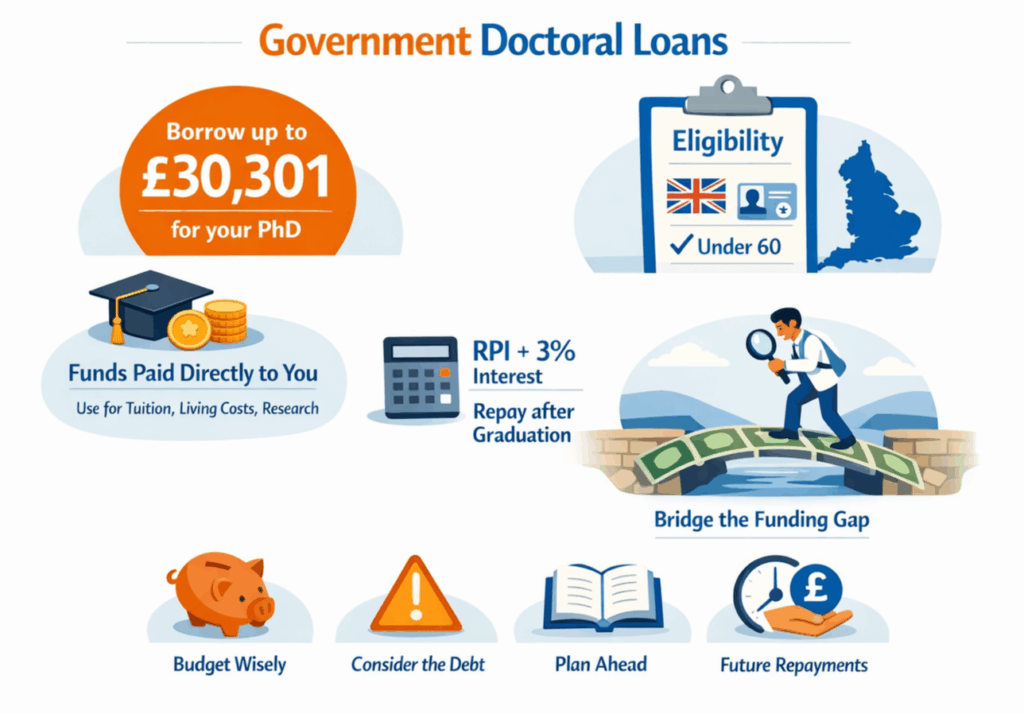
If scholarships and grants still leave a funding gap, the UK government’s Postgraduate Doctoral Loan is a crucial resource. This is essentially a student loan for PhD-level study, available to doctoral students who do not have full funding from other sources. It is not a scholarship (since it must be repaid), but it can provide a large injection of funds upfront to make undertaking a PhD possible.
Key features of the doctoral loan:
Loan amount:
For courses starting in the 2025/26 academic year, you can borrow up to £30,301 if you live in England. (Welsh students have a similar doctoral loan up to around £29,130) (Gov.uk, 2025; Prospects, 2025c). The maximum typically rises slightly each year with inflation. You don’t have to borrow the full amount – you can request a lower amount if you need.
Coverage:
The loan is paid directly to the student in instalments. You can use it towards anything – tuition fees, living costs, research expenses. Unlike an undergraduate loan, it’s not split into separate tuition and maintenance portions; you allocate it as needed. It is not means-tested, so household income does not affect it.
Eligibility:
Generally, UK nationals (and some with settled status) who are resident in England can apply. (The rules differ for Wales, Scotland, and Northern Ireland as they have their own postgraduate funding systems.) You must be under a certain age (currently under 60) to start. Importantly, you’re ineligible if you already have a PhD or equivalent, or if you receive a UKRI studentship (since that is considered full funding).
Repayment:
The doctoral loan is added to your student loan balance and will be repaid once you finish and earn above the income threshold (around £25,000 for postgraduates). The interest rate is typically RPI + 3%. Repayments are 6% of income over the threshold, and run concurrently with any master’s or undergraduate loan repayments. If not fully repaid after 30 years, the remainder is forgiven. Keep in mind that a £30k loan accrues interest and could take a long time to pay off on a researcher’s salary, so consider the debt burden carefully.
The doctoral loan provides flexibility – you can combine it with partial scholarships or part-time work. Many self-funded PhD students use the loan primarily to cover their tuition fees over the three years (for example, roughly £4.5k per year, ~£13.5k total). They then apply the remaining funds (around £16k) toward living costs, alongside their own savings or work income. Unlike grants, the doctoral loan is straightforward to apply for via Student Finance. You can even apply after your PhD has started; however, if you apply in your second year or later, you will not get the full amount – only the remaining years’ proportion.
One strategic use of the loan is as a bridge: it can allow you to begin your PhD while you continue applying for grants or scholarships. If you later win a scholarship, you could potentially borrow less or repay some loan early. But if external funding never materialises, be prepared for the reality of repaying the loan from your future earnings.
Finally, remember that taking a loan involves a personal financial decision. It shifts the cost to your future self.
Budget realistically:
Will the loan plus perhaps part-time work be enough to live on? (For context, the UKRI stipend of ~£20k is set as a subsistence level for a single student; borrowing ~£30k over 3–4 years gives you about £10k per year, so additional funds would likely be needed.) Many students find the loan worthwhile – essentially investing in their education – but ensure you understand the terms and have a plan for managing the debt.
Crowdfunding and other creative routes
In recent years, some enterprising students have turned to crowdfunding to support their studies. Crowdfunding involves raising many small contributions from the public, usually via online platforms, by pitching your story or project. While commonly used for charitable causes or business startups, some students have used it to fund postgraduate education (Prospects, 2025b). This route is unconventional and success is not guaranteed, but it can be a viable supplementary strategy for motivated students with a compelling narrative.
How crowdfunding works:
You create a campaign on a platform (such as GoFundMe, JustGiving, or a specialised academic crowdfunding site like Hubbub). You set a target amount and deadline, and promote your page through social media, email, and community networks. Typically, you explain who you are, what your research is about, why it matters, and how their donations will help (Prospects, 2025b). Often, students offer incentives for different donation levels – for example, a £20 donor gets a personal thank-you and updates, a £100 donor gets mentioned in the thesis acknowledgements, etc. It helps to be creative: some have offered small tokens or opportunities (e.g. a chance to attend a lab open day or receive an artwork related to the research).
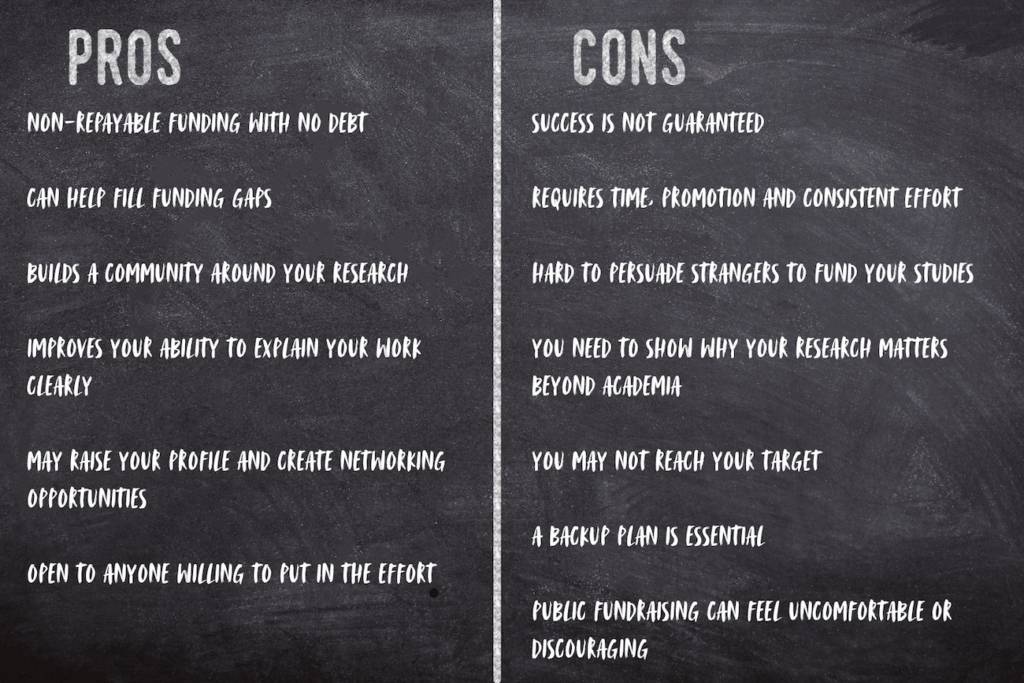
Pros of crowdfunding:
- It provides non-repayable funds (essentially donations) that can fill gaps without incurring debt (Prospects, 2025b).
- A successful campaign can build a community of supporters for your research. These backers might take an active interest in your progress, which can be encouraging and useful for networking.
- Launching a campaign forces you to communicate your research clearly to a general audience – a useful skill in itself. If you manage to get media coverage or go viral online, it can raise your profile as an early-career researcher.
- There are no eligibility restrictions; anyone can attempt it, regardless of academic record or background, as long as you’re willing to put in the effort.
Cons and challenges:
- Crowdfunding is far from a sure thing. Success rates vary and many campaigns do not reach their targets. You will need to invest considerable time into marketing your campaign, which can be difficult alongside PhD work (Prospects, 2025b).
- It may be easy to get friends and family to contribute, but motivating strangers to donate to your education is hard. You must convince people why your PhD matters to the world, not just to you. For instance, explain how your research could benefit society or advance knowledge in a way that people outside academia care about.
- You must be prepared for the possibility of not reaching your goal. Although some platforms let you keep funds raised even if short of the target, you should have a backup plan if the amount is insufficient (Prospects, 2025b).
- There is a personal aspect: you have to be comfortable making a public appeal for funding, which not everyone likes. And if the campaign goes slowly, it can feel disheartening.
Tips for successful crowdfunding (drawn from past cases and expert advice):
Plan thoroughly before launching:
Identify likely donors (start with personal contacts, but also think about communities interested in your field). Figure out how you’ll reach them – via social media, local press, alumni networks, etc. Prepare some content (posts, perhaps a short video) in advance.
Tell a captivating story:
Make your campaign engaging and relatable. Explain what led you to pursue this PhD and what difference it will make. Emphasize any societal impact. For example, you might say “This PhD could help develop a new therapy for [a disease],” or “It will document endangered languages for future generations.” People are more inclined to donate if they find the cause meaningful.
Use media and networks effectively:
Leverage Twitter (X), Facebook, Instagram, LinkedIn and any other platform to spread the word beyond your immediate circle. Sometimes a human-interest story can attract press attention, which greatly boosts donations. Don’t be shy about contacting local newspapers or radio with your story – you being a future researcher in need can be a compelling angle.
Set realistic goals:
Set a target that is ambitious but not impossible. Asking for the full £60,000 for a 3-year PhD might deter donors, but aiming for £5,000 to cover a specific expense (like lab equipment or a year’s accommodation) is more achievable. Always thank your contributors and keep them updated on your progress. Their goodwill and continued support can be invaluable, especially if you need to fundraise again for a subsequent year.
Learn from others:
Thousands of students have partially or fully funded their studies this way, so there are plenty of case studies. See if you can find blogs or articles by those who crowdfunded a degree, and even reach out to them for tips (Prospects, 2025b).
Crowdfunding, at its core, is usually supplementary. Few students will crowdfund 100% of a PhD’s cost, but as part of a broader funding strategy, it can provide a critical few thousand pounds and a morale boost. One UK student famously raised £26,000 to fund her Master’s degree through public donations – showing that the generosity of many small donors can add up. While results vary, this route is at least worth knowing about, as it truly goes “beyond the obvious” methods.
Other creative routes:
- Prizes and competitions: Keep an eye out for any competitions (essay contests, pitching research ideas, etc.) in your field that offer cash prizes or grants. Winning a small award could contribute to your funding and strengthen your CV.
- Savings and frugal living: It sounds basic, but part of “funding” a PhD sometimes involves lowering your costs. Choosing a university in a city with lower living expenses, or living with family if possible, can reduce the amount of money you need. Some students work for a year or two before the PhD to build savings that will support them during their studies.
- Part-time study: Enrolling part-time effectively doubles the duration of a PhD but allows you to work alongside it to earn income. A part-time PhD can be self-funded more manageably because you spread tuition payments out and have more time to earn. However, be cautious: part-time study still entails significant time commitment and your income must cover many more years of living costs (FindAPhD, 2025). The total cost may end up similar or higher; this route is best for those with a stable job who can integrate study with work.
In the end, think of these creative approaches as bridges to your goal. Each small contribution – whether from an individual donor or an award from a niche foundation – is a step closer to making your PhD financially feasible.
Applying for PhD funding: tips for success
With the multitude of funding sources outlined, the next challenge is winning them. All the scholarships and grants in the world are only useful if you can convince selectors that you deserve the support. Crafting strong applications is paramount. Here are strategies to boost your success rate:
1. Research and target opportunities wisely:
Align your application to what the funder is looking for. Read the guidance for each scholarship or grant closely. If a research council prioritises interdisciplinary impact, emphasise that in your proposal. If a charity cares about practical outcomes, highlight the potential benefits of your work. Tailoring each application shows you’re not just mass-applying, but genuinely addressing their criteria.
2. Prepare a compelling research proposal:
At PhD level, many funding decisions hinge on the quality of your research plan. Make sure your proposal is clear, rigorous, and imaginative. State your aims and research questions, situate it in relevant literature, outline methodology, and explain why it matters. A strong proposal conveys excitement and significance – it should convince the reader that your project is worth funding because it advances knowledge or addresses an important problem. Have your supervisor (or another mentor) review drafts; their experience in securing grants can be invaluable.
3. Showcase your excellence and potential:
Funding bodies invest in people as much as projects. Use your personal statement or application answers to demonstrate your preparation and passion. Highlight relevant achievements – academic awards, publications, conference presentations, or work experience that evidences your skills. If you overcame challenges or followed a non-traditional path, explain what you learned; this can show resilience and commitment. Above all, convey dedication to your field and let your genuine interest shine through.
4. Get strong references:
Almost all funding applications require recommendation letters, typically from professors or professional mentors who know your work. Choose referees who can comment specifically on your research ability and work ethic. It’s better to have a lesser-known professor who supervised your project and can speak in detail, than a famous name who barely knows you. Brief your referees on what you are applying for so they can emphasize relevant qualities. A lukewarm or generic reference can undermine an otherwise strong application, so cultivate these relationships early.
5. Polish your documents and follow instructions:
This sounds obvious, but it’s where many applications fail. Proofread everything carefully. Spelling or grammatical errors, sloppy formatting, or missing components can signal a lack of care. Adhere strictly to word limits and formatting rules set by the funder (Prospects, 2025a). If they ask for a 2-page CV, do not send 5 pages. If an application form has specific questions, answer them directly and thoroughly. It can help to have a friend or family member (especially someone outside your field) read your application – they can spot unclear explanations or mistakes you missed.
6. Apply early (and widely):
Start your funding search well ahead of your intended start date. Many major scholarships close 6–9 months before the PhD begins. By starting early, you give your referees ample time and also leave open the possibility of resubmission if an application fails – for example, some scholarships have multiple rounds, or you could try again next year. Don’t pin all your hopes on one source; apply to multiple opportunities to improve your odds. It is often a numbers game: increasing the number of quality applications you submit increases the chance that one will succeed.
7. Leverage support networks:
You do not have to do this alone. Seek guidance from your current or past university’s careers service or postgraduate funding advisors. Many institutions offer workshops on writing PhD proposals or grant applications – take advantage of these. If you know current PhD students, ask them how they got funded; they might tip you off to niche opportunities or even share successful applications as examples. Online communities (like the #phdchat hashtag on X/Twitter or forums) can also provide moral support and leads.
8. Stay persistent and positive:
Rejection is common in funding quests. It is important not to take it as a verdict on your worth or potential. Often there are far more qualified applicants than awards, and decisions can hinge on tiny differences or external factors. If you get a rejection, see if feedback is available – even if not, reflect on how you might strengthen your next application. Many successful PhD students faced one or more rejections before securing funding. Learn from each attempt and keep refining your approach.
In summary, a successful funding application aligns with the funder’s goals, stands out for its clarity and enthusiasm, and demonstrates that you are the right person to invest in. By combining diligent preparation with genuine passion, you can significantly increase your chances of turning an opportunity into an actual offer.
Budgeting and managing finances during a PhD
Even after securing funding, prudent financial management is crucial throughout your PhD. Stipends and scholarships are inherently limited, and if you have partial funding (or a loan), you will need to stretch resources to cover your living costs over several years. Here are some budgeting tips and considerations for PhD students:
Make a detailed budget:
Start by calculating your essential expenses – tuition (if you’re paying fees), rent, utilities, food, commute, and research-related costs (books, software, printing, etc.). Compare this against your known income (stipend instalments, savings, any wages from teaching jobs). Many students find it helpful to use a budgeting app or spreadsheet to track all spending (Webb, 2020). By monitoring your cash flow, you can identify areas to cut back and avoid running out of money unexpectedly.
Split up lump sums:
PhD funding is often paid in large, infrequent instalments (e.g. quarterly stipends or a whole term’s loan at once). A smart technique is to simulate a monthly salary for yourself. For instance, when your stipend or loan arrives, immediately put it in a separate savings account, and then transfer a fixed “allowance” to your current account each month or week (Webb, 2020). This prevents overspending early on and ensures you have funds spread evenly across the year. It requires discipline, but many students credit this with keeping their finances steady.
Live frugally and take advantage of student perks:
As a postgraduate you are still eligible for student discounts – use them for travel (Railcards, discount bus passes), software, books, and in shops or restaurants. Consider affordable housing options: maybe a house-share with other students, or becoming a residence assistant (which can reduce accommodation costs). Cooking at home instead of eating out, and buying secondhand where possible, can save a lot. Universities often have hardship funds or small emergency grants. Know how to access these if you ever face a financial crisis – many PhD students do at some point (for example, when hit with an unexpected expense).
Augment income cautiously:
If your funding doesn’t fully meet your cost of living, consider safe ways to earn extra money that won’t derail your PhD progress. Common options include:
- Teaching or tutoring: Many funded PhD students take on a few hours per week of undergraduate teaching or lab demonstrating for extra pay. If you’re not funded, you can often sign up as hourly teaching staff. Private tutoring (online or in person) in your subject can also command good rates.
- Research assistance: Your department might have grant-funded projects needing part-time research assistants. If related to your field, this can be both financially and academically rewarding.
- Freelance or consultancy work: Some students do freelance writing, programming, design, or translation work in their spare time. The flexibility of freelance gigs can help you earn income during less busy periods of your PhD.
Keep in mind not to overcommit – your PhD is itself a full-time endeavor. Many universities recommend no more than 6–10 hours per week of paid work for full-time research students. Try to find work that is flexible and, ideally, skill-building for you.
Plan for the long term:
A PhD typically takes at least 3 to 4 years full-time. If you have a three-year funding package, think ahead about the “writing-up” period. Will you have funding in year 4 if needed, or do you need to save from earlier years to cover that time? Some students deliberately under-spend in the early years and set aside a portion of their stipend, so that if funding runs out before completion, they have a cushion. It’s also wise to set aside some money (if possible) for special opportunities. For example, attending an international conference or doing a research visit can greatly enhance your work. Having some savings earmarked for these purposes makes it easier to seize such opportunities when they arise (even though supervisors or departments can sometimes help, it’s not guaranteed).
Seek advice and support:
Most universities have a student money adviser or a student union welfare officer who can help you with budgeting and finance management. They can also ensure you are receiving any small pots of money you might be entitled to. For example, if you have a disability, look into Disabled Students’ Allowances. If you have children, there may be grants or state benefits for student parents. Make sure to claim what is available. Talking openly about money can be a relief – don’t hesitate to reach out if you are struggling financially. The PhD journey is challenging enough without undue financial stress.
In sum, budgeting is about balance: making your funds last while maintaining a reasonable quality of life. You don’t want to spend three years in extreme austerity if it’s avoidable – that can harm your mental health and productivity. Allocate some personal spending for socialising or hobbies within your means. A well-managed budget will let you focus on research rather than constantly worrying about bills. And if you find partway through your PhD that you are running short of funds, do not panic. Remember the funding sources discussed earlier – it is never too late to apply for a top-up grant or adjust your plan. In fact, many charities will consider applications from students who are already partway through their PhD.
Case study: piecing together a PhD through multiple funding sources
To illustrate how all these funding avenues can come together, consider the real example of Luke Blaxill, a student who successfully self-funded his PhD by securing numerous small grants (Blaxill, n.d.). After being rejected twice for a research council award, Blaxill began a part-time History PhD with no major funding. Facing an estimated £40,000 shortfall for tuition and living costs, he adopted a strategy of applying for any and every grant he could find.
He started locally: his university provided a few small hardship and travel grants (£250–£1,000 each), and in his second year he won an £8,000 college bursary – a significant boost. Through academic societies like the Royal Historical Society, he obtained annual grants of a few hundred pounds. Still, this was not enough. Blaxill then scoured directories for obscure charitable trusts, sending out dozens of enquiry letters. Rejections poured in, but he persisted. Eventually, a London-based educational trust awarded him £1,000, which he then leveraged in applications to others – mentioning one charity’s support made others more inclined to contribute. Over time, he secured funding from multiple trusts tied to his personal background. For example, a foundation connected to his father’s line of work granted him about £10,000 over two years. He also won general study grants from organizations such as the Sir Richard Stapley Trust (Blaxill, n.d.).
By the end of his PhD, Blaxill had amassed a mosaic of funding nearly equivalent to a full studentship. It was by no means easy – he recounts numerous “rejections, dead ends, and fallow periods” between successes. The key was dogged persistence and treating the search like a job in itself. He advises other students in his position to not give up: even if the first ten applications fail, the eleventh might succeed. His story demonstrates that by being persistent and resourceful, it is possible to combine smaller scholarships, grants and loans creatively to finance a PhD when traditional funding is elusive.
The takeaway from this case is twofold. First, explore every potential resource: a small grant that seems hardly worth the effort might be the one that fills your last funding gap or leads to another opportunity. Second, maintain determination and resilience. Funding hunts can be demoralising, but as with research, persistence is often rewarded.
Conclusion
Funding a PhD in the UK may feel like navigating a maze. However, as we have shown, there are many routes through it – and at the end, a doctoral degree without crippling debt is an achievable goal. By leveraging a combination of scholarships, grants, loans, and creative strategies, prospective PhD students can solve the “how will I pay for this?” dilemma.
This guide has outlined the main avenues – from coveted UKRI studentships and university scholarships, to the patchwork of charities and professional bodies, and even newer ideas like crowdfunding and employer sponsorship. Equally importantly, we discussed how to approach applications strategically and manage your finances wisely along the way. The core message is one of proactivity and breadth. Cast your net wide, be resourceful, and don’t be afraid to seek support from multiple corners. What you lack in guaranteed funding, you can make up for in effort and planning.
Embarking on a PhD is daunting, but money, while a challenge, need not be an insurmountable barrier. In the UK, there is substantial investment in research and training – the task is to connect your ambition with the right funding source. Whether it is persuading a panel that your project merits a scholarship, or rallying community support for your cause, you have avenues to explore. With determination, your PhD dream can be within financial reach. Good luck with your funding quest and your doctoral journey ahead!
Need a model proposal for your funding application?
An experienced specialist in your subject will write a complete model research proposal based on your research idea and funding application requirements.
Already written your draft? Get help with editing or get marking and feedback.
References
- Blaxill, L. (n.d.) How I self-funded my part-time PhD – Alternative Guide to Postgraduate Funding (postgraduate-funding.com). [Online]. Available at: https://www.postgraduate-funding.com/luke
- British Council (2024) Scholarships and funding – Postgraduate funding in the UK. [Online]. Available at: https://study-uk.britishcouncil.org/scholarships-funding
- FindAPhD (2025) A simple introduction to PhD funding. [Online]. Available at: https://www.findaphd.com/guides/phd-funding-guide (Accessed 9 October 2025).
- Gov.uk (2025) Doctoral Loan: What you’ll get. [Online]. Available at: https://www.gov.uk/doctoral-loan/what-you-get
- Prospects (2025a) PhD studentships 2025: how to get PhD funding. Prospects.ac.uk, May 2025. [Online]. Available at: https://www.prospects.ac.uk/postgraduate-study/phd-study/phd-studentships
- Prospects (2025b) Crowdfunding your Masters. Prospects.ac.uk, June 2025. [Online]. Available at: https://www.prospects.ac.uk/postgraduate-study/funding-postgraduate-study/crowdfunding-your-masters
- Prospects (2025c) PhD loans in England 2025. Prospects.ac.uk. [Online]. Available at: https://www.prospects.ac.uk/postgraduate-study/funding-postgraduate-study/phd-loans-in-england
- UK Research and Innovation (2025) Get a studentship to fund your doctorate. UKRI (ukri.org). [Online]. Available at: https://www.ukri.org/apply-for-funding/studentships-and-doctoral-training/get-a-studentship-to-fund-your-doctorate/
- Webb, S. (2020) ‘Budgeting as a PhD student’, UCL Students News, 4 December 2020. [Online]. Available at: https://www.ucl.ac.uk/students/news/2020/dec/budgeting-phd-student

Cite This Work
To export a reference to this article please select a referencing stye below: