
PhD application timeline and checklist
Info: 5748 words (23 pages) Study Guides
Published: 12 Apr 2026

UK Essays writing support
Preparing a research proposal for your PhD application?
We’ll write a complete model research proposal based on your research idea and application requirements.
Send us your research idea and, if you wish, any university guidance. An experienced specialist in your subject will write your model proposal from scratch.
All our writers hold at least a 2:1 degree from a reputable university. Most hold a master’s degree or PhD, and/or have teaching experience.
Applying for a PhD can feel overwhelming because it involves juggling many components – research proposals, references, funding applications, visa paperwork and often interviews. However, with a clear timeline and structured plan, you can stay on track and handle each task at the right time.
This guide breaks down the 12 months leading up to your PhD start date into stages. These include 12 months, 9 months, 6 months and 3 months before enrolment. Each stage includes a detailed checklist.
For example, one PhD student observed that the application process was much lengthier than a master’s. It required multiple tailored research proposals and early contact with potential supervisors (Pullen, 2017). Therefore, starting early is essential.
Planning out all key deadlines from the beginning gives you ample time to gather documents. It also gives your referees enough time to write strong recommendation letters without rush (Collie, 2024).
In short, the timeline below provides a clear roadmap from initial research to final preparations. It helps ensure nothing is overlooked, from identifying a supervisor to securing funding and arranging your visa (Osborne, 2022; Evolvi, 2021).
You can even personalise this plan by inputting your target start date and adjusting each milestone accordingly. This helps ensure you are fully prepared to embark on your doctoral journey.
About a year before your intended PhD start, begin laying the groundwork.
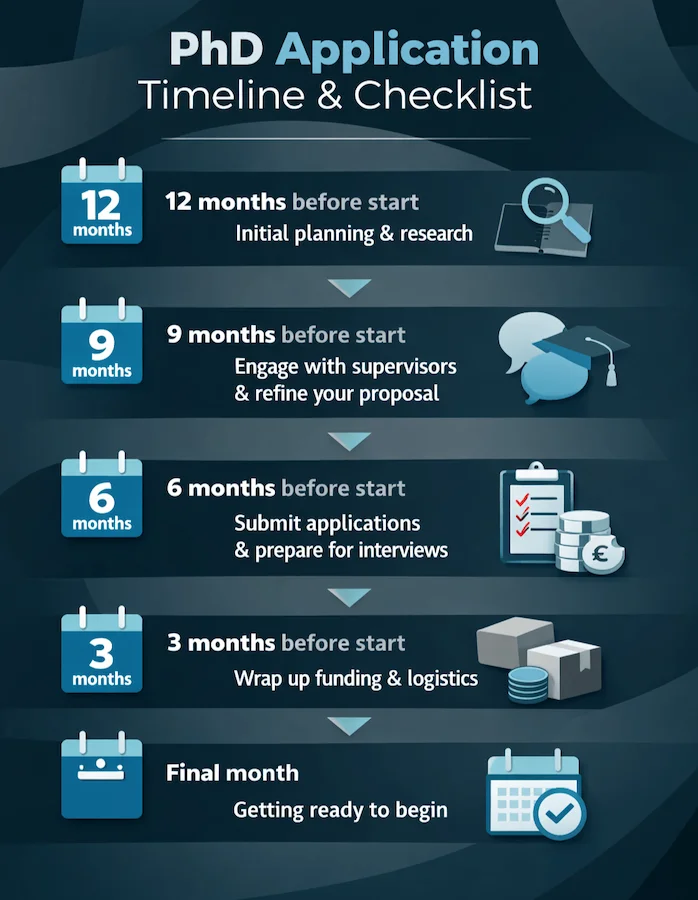
12 months before start – initial planning and research
Firstly, clarify the kind of PhD you are aiming for, as this will shape your approach. Depending on your field, you might either apply for a pre-defined doctoral project, which is more common in STEM disciplines, or propose your own research topic, which is typical in the arts and humanities.
If you plan to apply for an advertised funded project or studentship, you will usually need to submit a statement of interest. Successful applicants are then typically assigned a supervisor. If you intend to propose your own research instead, you must decide on a specific topic. You will also be expected to write a detailed research proposal (Osborne, 2022).
In either case, this early period is about exploration and preparation. The following steps will set a strong foundation:
Identify your research interests:
Define the broad field or problem area you want to investigate. Make sure it genuinely excites you and sustains your curiosity. You will be dedicating at least three to four years to this topic. In the humanities, for example, a PhD is largely self-driven. It is therefore vital to choose a topic you care about and find motivating (Pullen, 2017). Begin reading recent literature to refine your ideas and identify gaps your project could fill.
Research potential programmes and supervisors:
Investigate which universities have strengths in your chosen area. Look up academic departments and faculty profiles to find potential PhD supervisors whose research aligns with your interests. Compile a list of prospective programmes and note the professors or research groups that appeal to you. This may involve using university websites, academic publications and PhD search platforms to see where similar work is being done.
Note application deadlines and requirements:
Create a calendar of important dates for each target university. As soon as you know which programmes you will apply to (and any scholarship schemes you might try), find all their deadlines and mark them clearly (Collie, 2024). This includes application due dates, but also dates for funding applications or entrance exams. Knowing the timeline now will allow you to backward-plan each task. This approach gives you enough time to compile your CV, transcripts, research proposal drafts and other documents, and also gives your referees plenty of notice to prepare their reference letters (Collie, 2024).
Check prerequisites and eligibility:
Ensure you will meet the entry requirements of your chosen programmes. Typically you need a strong undergraduate degree (and often a master’s degree) in a relevant field. Verify any minimum grade or GPA requirements and language proficiency criteria. If an English language test (such as IELTS or TOEFL) is required for international applicants, note the required score. Planning ahead here will inform you if you need to take any additional steps (for example, registering for an English test or taking the GRE for US programmes) in the coming months.
Plan for required exams:
If your target programmes require standardised tests – for instance, the GRE or GMAT for some doctoral programmes, or an English language test for non-native speakers – plan when to take these. Register for the exams well in advance. Ideally, allow time to retake a test if needed. Starting preparation around this stage will ensure you can achieve the required scores before applications are due.
Begin contacting mentors for advice:
You do not have to contact potential PhD supervisors just yet (that will come later), but it can be helpful to seek guidance from mentors or current PhD students. Discuss your research interests with former professors, lecturers or professionals in your field. They might offer advice on refining your research question or suggest suitable departments and supervisors. These conversations can also boost your confidence and help clarify what you want to pursue.
Start exploring funding options:
Now is also the time to research how you will fund your PhD. Look into scholarships, grants or doctoral studentships offered by universities, government bodies or trusts in your field. Many major funding opportunities, such as national scholarship schemes or international funding programmes, have application deadlines as early as 9–12 months before the PhD start. Make a list of funding sources you are eligible for and note their deadlines. Give yourself ample time to prepare any separate funding applications. External funding bodies often have their own forms and requirements, and these may include research abstracts or personal essays. Early awareness of funding timelines is crucial because funding applications may need to be submitted well before the university’s PhD application (Osborne, 2022).
At this 12-month stage, your goal is to gather information and prepare yourself. By identifying where you want to apply, what each programme expects and how you will meet those expectations, you create a solid roadmap. This upfront investment in planning will make the subsequent steps much more manageable.
9 months before start – engage with supervisors and refine your proposal
As you reach roughly nine months before your desired start date, it is time to intensify your preparations.
By now, you should have a clearer idea of your research direction and the universities you will apply to.
At this stage, focus on establishing contact with potential supervisors, assembling your application materials, and refining your research proposal and other documents. Key actions for this phase include:
Reach out to potential supervisors:
This is the ideal time to begin contacting academics who could supervise your PhD. Shortlist two or three faculty members at your target universities whose research specialisations closely match your intended topic. Take an in-depth look at their recent publications and projects so you can craft a personalised email to each (Osborne, 2022).
In your message, introduce yourself and explain your academic background (e.g. your master’s research or work experience), then concisely describe your proposed research idea. Importantly, articulate how your interests intersect with the professor’s expertise or ongoing research (Osborne, 2022). A personalised, well-informed email is more likely to get a positive response.
Politely ask if they might be interested in supervising a PhD on the topic you propose, or if they can offer any advice on your proposal. Reaching out early – many months before the official application – shows initiative. It also gives you a chance to gauge the professor’s interest and get feedback. (It is common for PhD applicants to contact prospective supervisors at this stage (Pullen, 2017), and many academics expect or appreciate this early communication.)
If you do not hear back within a couple of weeks, you can send a gentle follow-up. And if a supervisor indicates they are unable to take on new students or your idea is not a good fit, you still have time to approach an alternative from your shortlist.
Draft and refine your research proposal:
By nine months out, start writing a draft of your research proposal (if your applications require one). Even if some universities only ask for a shorter research statement, it is wise to prepare a full proposal now – you can later abridge or tailor it as needed.
Your proposal should clearly define your research question or hypothesis, review relevant literature to show the context and gap your work will address, and outline your methodology or approach. Explain the potential original contribution of your research. Furthermore, plan a tentative timeline for the project (for example, how you might conduct research over 3–4 years).
Writing this draft early allows you time to seek feedback. You might ask a mentor, or even a potential supervisor who has shown interest, to critique your proposal. Be prepared to revise it multiple times.
A well-thought-out proposal not only strengthens your application but also helps in discussions with supervisors.
Prepare your personal statement and CV:
Alongside the research proposal, most PhD applications require a personal statement (or statement of purpose) and an academic CV. Use this period to work on these documents. In your personal statement, convey why you want to do a PhD and why you are applying to that programme. Emphasise your academic preparation, research interests and career goals. Tailor each statement to each university – mention specific features of the programme or faculty that attract you. On your curriculum vitae, update any new publications, conference presentations, awards or relevant work experience. Ensure your CV is focused on academic achievements and skills (e.g. research methods you are proficient in). It can be useful to have a professor or careers adviser review these drafts.
Secure your referees:
Identify who will write your recommendation letters, typically two or three referees. They are often faculty members who know your academic work well (or sometimes an employer if you have significant relevant work experience). Now is the time to contact them, because you want to give your referees plenty of advance notice (Collie, 2024).
Politely ask if they are willing to provide a strong reference for your PhD applications. Provide them with all the information they might need: the programmes you are applying to, deadlines for each reference, and your research proposal or statement of purpose for context.
Starting early not only shows respect for their time, but also gives you the opportunity to find an alternative referee if someone is unavailable. As an example of timing, one successful applicant began emailing potential referees in mid-September for December and January application deadlines – roughly two-and-a-half months in advance (Collie, 2024). This lead time is advisable, as professors often have many reference requests.
Once your referees agree, make sure to follow up closer to the deadline with gentle reminders and any submission instructions (for instance, some universities email referees a link to upload the letter).
Take required exams (if not done yet):
If you still need to take any language proficiency test or other entrance exam, do it by this point. Many application deadlines are approaching in the next few months, and you will need official score reports. Taking the exams around 9 months before start allows time for retakes if your score was lower than needed. After the test, arrange for the testing agency to send your scores directly to the universities (note that this can take a few weeks). An early exam also means you can report your scores in the application forms confidently.
Apply for scholarships and funding:
Around nine months before the PhD, many scholarship deadlines will be closing. Ensure that you submit any external funding applications around this time. For example, government-funded scholarships, Fulbright programmes, or other international studentships often have fall or winter deadlines (roughly 8–10 months before the academic year). Likewise, if the universities themselves offer doctoral scholarships that require a separate form, complete those now. Pay close attention to what each funding application requires – some may ask for essays, research abstracts, or financial documentation. Keep in mind that the timelines for funding decisions may differ from admission offers. Osborne (2022) notes that you should give yourself plenty of time to research funding options and be aware of their separate deadlines. By applying for funding early, you improve your chances of having financing in place by the time you receive an admission offer.
Continue academic engagement:
If possible, use this period to further strengthen your profile. For instance, you could attend academic webinars, workshops or conferences in your field (even virtual ones). Not only will this deepen your knowledge, but it might also be something you mention in your personal statement to demonstrate your commitment. If you are finishing a master’s thesis or research project, devote effort to making it excellent, as this could later serve as a writing sample or be discussed in your application. Everything you do now that is scholarly or professionally relevant can bolster your readiness for PhD study.
By the end of this 9-months-prior stage, you should have made contact with potential supervisors, assembled strong drafts of your proposal and supporting documents, and initiated all the necessary exams and references. You are now ready to move into the application submission phase with confidence that your materials and plans have been well prepared.
6 months before start – submit applications and prepare for interviews
Six months before your PhD start (approximately half a year out) is typically the time when applications are due or already under review. In many cases, this is the peak of the application process – you will be submitting your PhD applications (if you have not done so already) and then preparing for any subsequent interviews or decisions. At this stage, it is crucial to ensure each application you send off is complete, polished and tailored to the programme in question. Here is what you should be doing around the six-month mark:
Finalise and submit your applications:
Make sure all your application materials are ready and meet the specific guidelines of each university. This includes uploading your research proposal, personal statement, CV, transcripts, and any required writing samples or portfolio. Double-check that your referees have submitted their letters (most application portals will show the status of recommendations).
It is often said that PhD applications should not be generic – each one must be customised for the target programme (Pullen, 2017). Indeed, you should submit a research proposal or statement of purpose specific to each course or department, addressing their particular research strengths and what you hope to do there (Osborne, 2022).
Take care to follow any formatting rules (such as word counts or section headings for proposals) given by the department. Before hitting “submit”, proofread everything carefully or have someone else review your materials. Ensure that the tone of your personal statement aligns with the programme’s ethos and that you have mentioned any faculty names or research groups correctly.
It is wise to submit a few days before the actual deadline if possible – this way, you avoid last-minute technical issues and show professionalism.
Tailor each research proposal to the programme:
As you finalise your proposals for submission, tailor them one last time for each university. Small adjustments can make a big difference. For example, you might emphasise a particular aspect of your project that resonates with the department’s focus areas, or reference the work of a faculty member you hope to work with. One applicant recalls producing unique research proposals for each university’s application, each one aligned with that department’s specific guidelines and strengths (Pullen, 2017). This kind of effort can impress admissions panels who can see that your project “fits” their environment. It shows that you have done your homework and are genuinely interested in their programme, not just any PhD.
Meet all deadlines and don’t rush:
By this point, you should have a clear idea of the application deadlines – many programmes might have deadlines around December to February for an autumn start, while some have later or rolling deadlines. Aim to complete each application well before its cutoff date. Completing a PhD application (especially writing a thorough proposal) takes significant time and should not be left until the last minute (Osborne, 2022). Procrastination can lead to errors or weaker quality work. Therefore, manage your time so that you are not writing new content on the eve of a deadline. If you find yourself pressed for time, focus on the quality of a few well-targeted applications rather than spreading yourself too thin across too many.
Prepare for interviews or additional selection steps:
After submitting applications, the focus shifts to the next steps in the selection process. Many PhD programmes will interview short-listed candidates, either in person or via video call. In some cases this happens around 1–3 months after the application deadline (often roughly 4–5 months before the start date).
To prepare, think about how to articulate the importance of your research and your motivation for doing a PhD. You might be asked about your academic background, how you plan to approach the project, or how you will handle the challenges of doctoral study. Practice answering common interview questions with a friend or mentor.
If your field requires it, be ready for technical questions or to discuss literature in your area. Moreover, if you have identified a potential supervisor who is keen on your project, the “interview” might be more of an academic discussion with them and another faculty member.
Be prepared to discuss your proposal in depth: they may probe your knowledge of the topic or test how you handle feedback. Remember to convey enthusiasm, professionalism and a willingness to learn. Interviews are also an opportunity for you to ask questions, so consider what you want to know about the programme or supervision style.
Follow up and stay organised:
Keep track of all your submitted applications and any correspondence from universities. Most universities will send a confirmation email upon receiving your application – make sure you get these and that your application fees (if any) are paid. Create a spreadsheet or list to track: submission dates, interview dates (if scheduled), decision release dates (if known), and any post-application requirements. For instance, some programs might ask for additional materials like a research paper or a project portfolio after initial review – be ready to provide those quickly. Continue to monitor your email (including spam folder) for any communication from admissions committees or prospective supervisors. Respond promptly and professionally to any requests.
Maintain momentum (and patience):
Once applications are in, there can be a waiting period of several weeks or months. Use this time wisely. Furthermore, continue reading in your research area to stay sharp for potential interviews. If you haven’t already, you could prepare a short presentation on your proposed research; occasionally, candidates are asked to present their project during an interview or visit day. On the other hand, it’s also important to manage stress during this period – ensure you balance preparation with rest. Knowing that you have submitted everything to the best of your ability, try to be patient while the decisions are pending. Keep in mind that some offers may come earlier or later than others, as timelines vary by institution.
At six months before the start, if you have adhered to your timeline, you will have submitted all your applications and possibly even attended the first interviews or discussions. This is a significant milestone: the heavy lifting of applying is largely done. The focus will soon shift to the outcomes – receiving offers (hopefully) and making practical arrangements for your PhD journey.
3 months before start – wrap up funding and logistics
Around three months before your PhD begins, you will be moving from the application phase to the transition phase. By now, you should have received decisions from most programmes. You may be holding an offer (or multiple offers) for a PhD place. This stage is all about finalising your choice, securing funding, and arranging the practicalities of embarking on the PhD. In other words, this is when you switch gears from applying to preparing to actually start. Important steps during the final three months include:
Decide on your PhD offer:
If you applied to more than one programme, you might have more than one acceptance. Now you must choose your path. Weigh up the pros and cons of each offer – consider factors such as the research project, the supervisor, funding package, university reputation, location, and your overall comfort with the environment. You may also have deadlines by which to accept an offer (some offers will expire or require a formal acceptance by a certain date). Make sure to respond within the given timeframe. Once you have decided, notify the department of your acceptance as instructed (often by signing and returning an offer letter). It’s courteous to also inform other programmes that you are declining, so that they can potentially offer your spot to someone on the waiting list.
Confirm your funding arrangements:
By three months out, you should also clarify how your PhD will be funded. If your offer included a funded studentship or scholarship, ensure that you have completed any required paperwork to secure that funding. For example, you might need to sign a funding agreement or provide bank details for stipend payments.
If you were awaiting the results of external scholarship applications, those are usually announced around this time – if you won any, congratulations, and be sure to inform your department and coordinate how that external funding fits with or replaces any university funding.
In case you did not secure funding, you will need to make a financial plan: some students combine partial funding sources, or you might arrange personal or family funds, loans, or a part-time work plan (where allowed) to support yourself. It is essential to know before you start your PhD that you have the means to cover tuition and living expenses, since financial stress can severely impact your doctoral experience.
(If funding is still uncertain, consider reaching out to the university’s graduate funding office – sometimes additional funds or bursaries become available last-minute, and they can advise on any remaining options.)
Apply for your student visa (if needed):
Once you have an official admission offer and have accepted it, international students should immediately begin the student visa process (Evolvi, 2021). Visa applications can take several weeks or even a few months depending on the country, so starting about three months in advance is prudent. First, ensure you have a valid passport (with expiration date well beyond the duration of your PhD).
Gather the required documents
Next, gather the required documentation for the visa application. Almost all countries will require an official letter of admission from your university and proof of financial means to support yourself (Evolvi, 2021). This proof often takes the form of bank statements showing sufficient funds or a letter confirming your scholarship/studentship.
As Giulia Evolvi notes, even if a university did not initially ask you for financial proof during admissions, you will need to show you can fund yourself when you apply for the visa, if you have not been given a full scholarship (Evolvi, 2021). Additionally, you may need to provide evidence of language proficiency (for example, your IELTS score report) and other documents like a travel itinerary or proof of accommodation.
Check your country specific requirements
Some countries also require a health examination, biometric data (fingerprints), or a police clearance certificate – check the specific student visa requirements on the official government website. Submit your visa application as early as allowed, and schedule any required appointments (such as a visa interview or biometrics appointment) as soon as possible.
Keep copies of all documents you submit. Finally, once your visa is approved, make note of any entry conditions (some visas might specify entry by a certain date or require registration with local authorities on arrival).
If you are moving to the UK for your doctorate, see our international student’s guide to starting a PhD in the UK for practical advice on visas, documents, travel, accommodation and settling in.
Arrange accommodation and travel:
With your PhD place secured, you need to sort out where you will live and how you will get there. If you are moving to a new city or country, research housing options well ahead of time. Many universities offer postgraduate accommodation or dormitories – apply for these early, as demand can be high. If you plan to rent privately, start looking into neighbourhoods and pricing. You might travel to the area a month or two early to view flats, or join online groups for student housing. Aim to have accommodation confirmed at least a few weeks before moving, so you are not left scrambling upon arrival. Moreover, booking flights or other travel tickets about 2–3 months in advance can be cheaper and less stressful than last-minute arrangements. Ensure you arrive with a comfortable margin before your PhD programme’s start date or any orientation events. This gives you time to settle in, overcome jet lag, or handle administrative tasks (like enrolling in person, opening a bank account, etc.).
Complete any required paperwork:
In the final couple of months before starting, your university will likely send you information on enrollment or registration. Follow any instructions on completing pre-arrival forms or online registrations. You may need to provide copies of your previous degree certificates or final transcripts if you applied while still completing a degree. Make sure all your academic credentials are in order – for example, if your admission was conditional on finishing your MSc or on an English test score, send the proof that you met those conditions. It is much easier to handle these verifications before you start than after you arrive. Additionally, if you have special requirements (such as needing disability accommodations or arranging childcare), communicate with the university at this stage to set those up.
Stay in touch with your future supervisor and department:
It can be beneficial to connect with your PhD supervisor (if you have one assigned already) a few months before you start. You might send a courteous email updating them that you have accepted the offer and are excited to join the department. They might share reading materials or suggest you prepare by reviewing certain research before arrival. Building a rapport early is helpful. Similarly, watch for any emails from the department or graduate school about induction events, welcome sessions, or even social gatherings for new PhD students. Engaging with these communications will help you feel part of the community before you even arrive.
Plan for the transition to PhD life:
The last month or so before you begin is a good time to organise your personal affairs and prepare mentally for the doctoral journey. Tie up any loose ends at work if you are leaving a job, or finish any personal commitments. If you are moving abroad, ensure you have copies of important documents (passport, visa, academic certificates, reference letters) packed safely. You may also want to arrange health insurance if it is not provided, and plan finances (set up a bank account that works in the new country, etc.). On the academic side, consider revisiting your research proposal and notes – you will soon dive into intensive research, so refreshing your memory on your planned project and the literature is useful. You could draft a simple plan for your first few weeks (for example, which key papers to read or skills to learn early on). Finally, take care of yourself during this period. A PhD is a marathon, not a sprint, so it helps to start in a good physical and mental state. Take some time to relax and recharge before the exciting challenge begins.
With about three (or fewer) months remaining, you are essentially gearing up for the start of your PhD. By following the above steps, you ensure that when day one of your programme arrives, you will have funding in place, a roof over your head, all necessary documents sorted, and a clear mind ready to begin research. The logistical and administrative arrangements can be complex, but by tackling them methodically you have minimised last-minute surprises.
Final month – getting ready to begin
In the final weeks before your PhD starts, most of the major pieces should be in place. Now it is about fine-tuning and making sure you are personally ready for this new chapter. In this last stretch, attend to any remaining details and prepare yourself to hit the ground running:
Double-check documents:
A few weeks before departure or program start, go through all your important documents one more time. Do you have your passport and visa (with photocopies of each in case of loss)? Did you pack your university admission letter and any scholarship award letters? Keep these in your carry-on luggage if you are traveling. If your university required any documents on arrival (such as original transcripts or certificates), make sure those are readily accessible.
Reconfirm accommodation and travel:
Get in touch with your landlord or university housing to confirm your move-in date and key collection. Reconfirm your flight or travel bookings and note how much luggage you can bring (to avoid last-minute packing issues). It is also wise to plan your route from the airport or station to your accommodation in advance – for example, know whether you’ll take a taxi, train or if the university has a pickup service. Having these small plans set can reduce stress when you land in a new place.
Orient yourself academically:
In this final month, spend some time revisiting your research proposal and any reading list provided by your supervisor. You might not need to dive deep into work yet, but refreshing your familiarity with your research topic will make you more confident when you start. You could identify a few key research articles to read (or re-read) so that discussions with your supervisor early on will be well-informed. If you will be joining a lab or research group, read up on their recent publications. This shows initiative and can help you integrate faster.
Set personal goals and routines:
Think ahead about how you will manage your time and well-being during your PhD. Perhaps set some simple goals for the first month – like meeting with your supervisor to outline a plan, or exploring the campus facilities. Consider your daily schedule and work habits: for instance, plan to treat the PhD like a job with regular hours to maintain work-life balance. Also look up any student societies or activities you might want to join; having a support network and hobbies will help you settle in.
Final mental preparation:
Lastly, take a moment to acknowledge what you have achieved so far. You navigated a complex application process over many months – which required dedication and organisation – and now you are about to begin an exciting intellectual journey. Nerves are normal, but remember that the structured planning you have done will serve you well. In the days before starting, ensure you get enough rest and take care of practical things (such as setting up a local phone number or ensuring access to funds) so that you can focus on your research once you begin. Embrace some downtime with family or friends to recharge. Arriving with a fresh and positive mindset will make the transition to PhD life much smoother.
Carrying these skills into your PhD
As you commence your PhD, keep the checklist mentality alive. There will be new milestones – completing coursework (if any), passing progress reviews, conducting experiments or fieldwork, writing your thesis – and you can approach them just as methodically as you did with your application timeline. The skill of breaking down a big project into manageable steps is one that will serve you throughout your doctorate.
Looking back on the application journey
By following this month-by-month application timeline, you have tackled the PhD application process in an organised and thorough way. You identified your research direction early, connected with the right people, met all your deadlines, and secured your place (and the resources to undertake it).
This structured planning not only ensured that nothing was overlooked – from contacting supervisors to arranging visas – but also has given you confidence in your ability to manage large projects.
Applying for a PhD is undoubtedly demanding, but with a clear plan of action, it becomes a series of achievable tasks instead of an amorphous challenge. As you start your PhD, you can take pride in how far your preparation has brought you.
Good luck with your doctoral studies, and welcome to the beginning of an enriching academic journey!
Need a model research proposal for your PhD application?
An experienced specialist in your subject will write a complete model research proposal based on your research idea and application requirements.
Already written your draft? Get help with editing or get marking and feedback.
References
- Collie, H. (2024) How to ask for references for your postgraduate degree. Times Higher Education, 26 April. Available at: https://www.timeshighereducation.com/student/advice/how-ask-references-your-postgraduate-degree
- Evolvi, G. (2021) How to apply for a PhD in the US. Times Higher Education, 2 March. Available at: https://www.timeshighereducation.com/student/advice/how-apply-phd-us
- Osborne, B. (2022) How to apply for a PhD in the UK. Times Higher Education, 18 January. Available at: https://www.timeshighereducation.com/student/advice/how-apply-phd-uk
- Pullen, C. (2017) PhD diary: Preparing for a PhD. Times Higher Education, 19 September. Available at: https://www.timeshighereducation.com/student/blogs/phd-diary-preparing-phd
- Medha, T. (2022) The ultimate PhD application checklist for international students. FindAPhD. Available at: https://www.findaphd.com/guides/international-application-checklist

Cite This Work
To export a reference to this article please select a referencing stye below: