
How to do Harvard referencing
Info: 2631 words (11 pages) Study Guides
Published: 13 Apr 2026
Generate quick and easy Harvard references with our generator – no sign-up required! Visit the Harvard Referencing Generator here.
UK Essays writing support
Writing an assignment with Harvard references?
We’ll write a complete model answer to your assignment question, with appropriate sources, Harvard citations and a reference list.
Send us your question and, if you wish, any marking criteria. An experienced specialist in your subject will write your model answer from scratch.
All our writers hold at least a 2:1 degree from a reputable university. Most hold a master’s degree or PhD, and/or have teaching experience.
Harvard referencing is one of the most widely used citation systems in universities across the UK, Australia, and beyond. Whether you’re writing your first undergraduate essay or polishing a postgraduate dissertation, this guide will walk you through everything you need to know — from the basic principles to the finer details that can trip up even experienced students.
What is Harvard referencing?
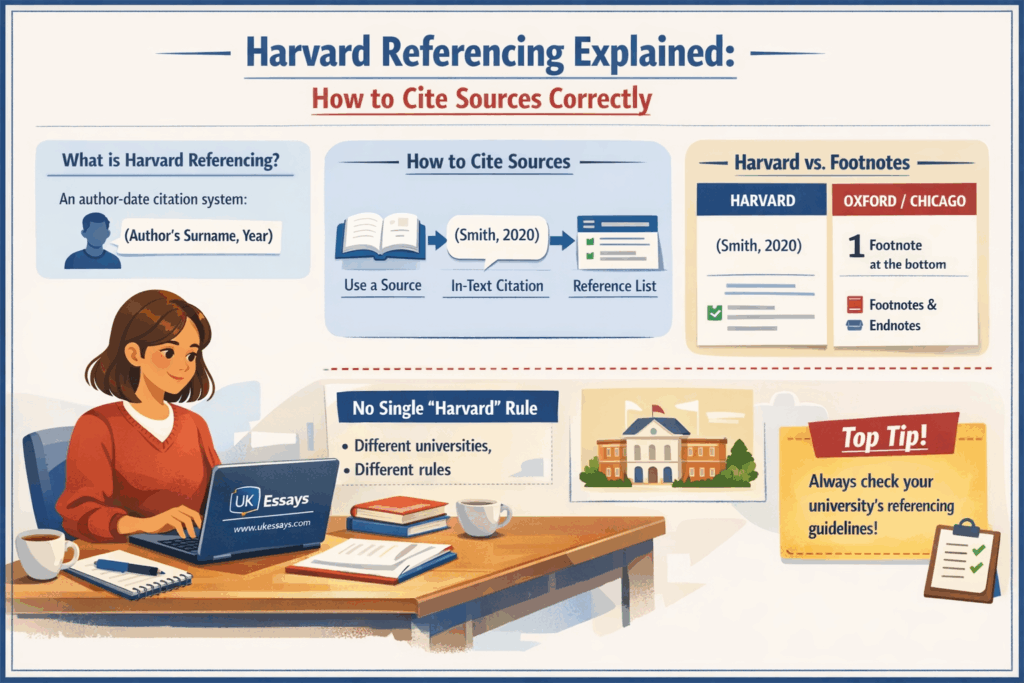
Harvard referencing is an author-date citation system. This means that whenever you refer to someone else’s work in your writing, you include the author’s surname and the year of publication in the body of your text (an in-text citation), and then provide the full details of every source in a reference list at the end of your work.
Unlike footnote-based systems (such as Oxford or Chicago), Harvard referencing does not use footnotes or endnotes for citations. Everything is handled through brief parenthetical references in your text, paired with a comprehensive alphabetical reference list.
Key point: Harvard referencing is not governed by a single official manual. It is a broad style of referencing, and different universities may have slightly different formatting rules. Always check your institution’s specific guidelines.
Harvard vs APA vs MLA: what’s the difference?
This is one of the most common points of confusion, so let’s clear it up.
| Feature | Harvard | APA (7th edition) | MLA (9th edition) |
|---|---|---|---|
| System type | Author-date | Author-date | Author-page |
| In-text format | (Smith, 2020) | (Smith, 2020) | (Smith 42) |
| Reference list title | Reference list / Bibliography | References | Works Cited |
| Governed by a single manual? | No (varies by institution) | Yes (APA Publication Manual) | Yes (MLA Handbook) |
| Uses footnotes? | No | No | No (endnotes optional) |
| Italicisation of titles | Varies | Yes (book/journal titles) | Yes (containers) |
Is APA the same as Harvard? Not exactly. APA is a specific, standardised style with precise rules set out in its publication manual. Harvard is a family of author-date styles that share the same general approach but vary in their details between institutions. They look very similar, but they are not interchangeable – always use whichever one your university requires. You can use our APA referencing generator here.
Is MLA the same as Harvard? No. MLA uses author-page citations rather than author-date, making it a fundamentally different system. See our MLA referencing guide here.
How Harvard referencing works: the two parts
Harvard referencing has exactly two components, and both are essential:
1. In-text citations
These appear in the body of your writing, immediately after the information you are citing. They tell the reader who said it and when.
2. Reference list
This appears at the very end of your work. It provides the full publication details of every source you cited in your text, arranged alphabetically by author surname.
If your reader sees (Jones, 2019) in your essay, they should be able to turn to your reference list, find the entry for Jones (2019), and locate the exact source.
How to write in-text citations
Basic format
The standard in-text citation includes the author’s surname and the year of publication:
Climate change is accelerating at an unprecedented rate (Smith, 2021).
If you mention the author’s name naturally in your sentence, only the year goes in brackets:
Smith (2021) argues that climate change is accelerating at an unprecedented rate.
Including page numbers
When you are quoting directly, paraphrasing a specific passage, or referring to a particular section of a long work, include page numbers:
This phenomenon has been described as “an existential turning point” (Smith, 2021, p. 45).
Smith (2021, p. 45) describes this as “an existential turning point.”
Use p. for a single page and pp. for a range (e.g., pp. 45–48).
Two authors
Include both surnames joined by “and”:
(Smith and Jones, 2021)
Smith and Jones (2021) found that…
Three or more authors
This is where et al. comes in. For works with three or more authors, use only the first author’s surname followed by et al. (which is short for the Latin et alia, meaning “and others”):
(Smith et al., 2021)
Smith et al. (2021) demonstrated that…
Note that et al. is not italicised in most Harvard styles, and there is a full stop after “al” because it is an abbreviation.
Some university Harvard guides use et al. from three authors; others only from four. A few older guides require you to list all authors the first time and use et al. only for subsequent citations. Check your institution’s specific guidelines. The most common current practice is to use et al. for three or more authors from the very first citation.
Multiple works by the same author in the same year
Add a lowercase letter after the year to distinguish them:
(Smith, 2021a)
(Smith, 2021b)
These letters should correspond to the order the works appear in your reference list (usually alphabetical by title).
Multiple sources in one citation
Separate them with semicolons, usually in chronological or alphabetical order:
Several studies support this conclusion (Jones, 2018; Smith, 2021; Taylor, 2022).
No author
Use the title (or a shortened version of it) in place of the author:
(Department for Education, 2020)
(‘Climate crisis deepens’, 2022)
No date
Use no date in place of the year:
(Smith, no date)
Secondary referencing (citing a source you found inside another source)
If you read about Smith’s findings in a book by Jones, and you cannot access Smith’s original work:
Smith (2015, cited in Jones, 2021, p. 36) argued that…
Only the source you actually read (Jones, 2021) appears in your reference list.
Direct quotations
Short quotations (usually fewer than 30–40 words) are enclosed in single or double quotation marks within the text:
According to Smith (2021, p. 12), the crisis represents “a fundamental challenge to existing governance structures.”
Longer quotations are typically indented as a separate block, without quotation marks, and followed by the citation.
How to write reference list entries
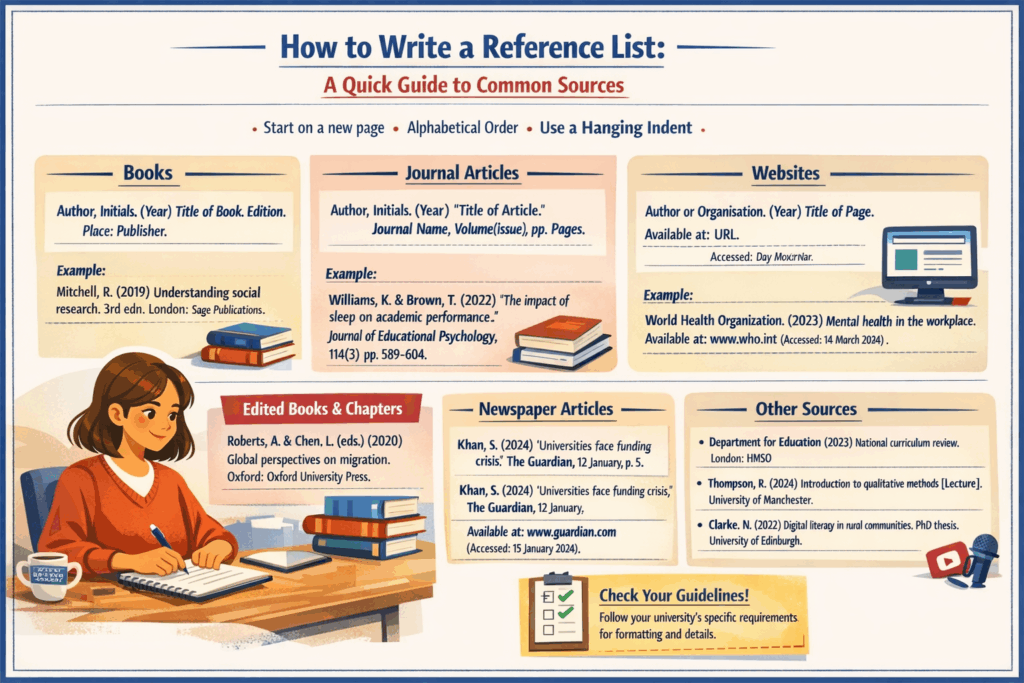
Your reference list should:
- Begin on a new page at the end of your work
- Be in alphabetical order by the first author’s surname
- Use a hanging indent (the first line of each entry is flush left; subsequent lines are indented)
- Include every source cited in your text (and only those sources)
Below are templates and examples for the most common source types.
Books
Template:
Surname, Initial(s). (Year) Title of book. Edition (if not the first). Place of publication: Publisher.
Example:
Mitchell, R. (2019) Understanding social research. 3rd edn. London: Sage Publications.
- The book title is in italics.
- Only the first word of the title (and proper nouns) is capitalised in most Harvard styles — this is called sentence case. Some institutions use title case; check your guidelines.
- Omit the edition if it is the first.
- Place of publication is sometimes omitted in newer Harvard guidelines — check your university’s preference.
Edited books
Roberts, A. and Chen, L. (eds.) (2020) Global perspectives on migration. Oxford: Oxford University Press.
Chapter in an edited book
Template:
Surname, Initial(s). (Year) ‘Title of chapter’, in Editor Surname, Initial(s). (ed(s).) Title of book. Place of publication: Publisher, pp. page range.
Example:
Patel, S. (2020) ‘Economic drivers of migration’, in Roberts, A. and Chen, L. (eds.) Global perspectives on migration. Oxford: Oxford University Press, pp. 45–72.
Journal articles
Template:
Surname, Initial(s). (Year) ‘Title of article’, Title of Journal, Volume(Issue), pp. page range.
Example:
Williams, K. and Brown, T. (2022) ‘The impact of sleep on academic performance’, Journal of Educational Psychology, 114(3), pp. 589–604.
If the article has a DOI, include it at the end:
Williams, K. and Brown, T. (2022) ‘The impact of sleep on academic performance’, Journal of Educational Psychology, 114(3), pp. 589–604. doi:10.1037/edu0000712.
If you accessed the article online but it has standard volume, issue, and page numbers, reference it as above (it is the same published article regardless of how you accessed it). If the article is online only and has no page numbers, include the DOI or the URL and the date you accessed it.
Websites
Template:
Author or Organisation. (Year) Title of page. Available at: URL (Accessed: day month year).
Example:
World Health Organization (2023) Mental health in the workplace. Available at: https://www.who.int/mental-health/workplace (Accessed: 14 March 2024).
If there is no date:
World Health Organization (no date) Mental health in the workplace. Available at: https://www.who.int/mental-health/workplace (Accessed: 14 March 2024).
Newspaper articles
Print:
Khan, S. (2024) ‘Universities face funding crisis’, The Guardian, 12 January, p. 5.
Online:
Khan, S. (2024) ‘Universities face funding crisis’, The Guardian, 12 January. Available at: https://www.theguardian.com/education/example (Accessed: 15 January 2024).
Government and organisational reports
Department for Education (2023) National curriculum review: final report. London: HMSO. Available at: https://www.gov.uk/example (Accessed: 20 February 2024).
Lecture notes and slides
Surname, Initial(s). (Year) Title of lecture [Lecture/PowerPoint presentation]. Module code: Module title. University name. Day month year.
Example:
Thompson, R. (2024) Introduction to qualitative methods [Lecture]. SOC2010: Research Methods. University of Manchester. 8 February 2024.
Theses and dissertations
Surname, Initial(s). (Year) Title of thesis. Type of qualification. Awarding institution.
Example:
Clarke, N. (2022) Digital literacy in rural communities. PhD thesis. University of Edinburgh.
YouTube video:
Surname, Initial(s). or Channel name (Year) Title of video. Available at: URL (Accessed: day month year).
TED (2020) The next outbreak? We’re not ready. Available at: https://www.youtube.com/watch?v=example (Accessed: 5 May 2024).
Social media post:
Surname, Initial(s). or Username (Year) Content of post (first 20 words) [Platform]. Day month. Available at: URL (Accessed: day month year).
Podcast:
Surname, Initial(s). (Year) ‘Title of episode’, Title of Podcast [Podcast]. Day month. Available at: URL (Accessed: day month year).
Image or photograph:
Creator (Year) Title of image [Type of image]. Available at: URL (Accessed: day month year).
Legislation (UK Acts of Parliament):
Title of Act year, c. chapter number. Available at: URL (Accessed: day month year).
Equality Act 2010, c. 15. Available at: https://www.legislation.gov.uk/ukpga/2010/15 (Accessed: 10 April 2024).
What does Harvard referencing look like in practice?
Here is a short example paragraph with properly formatted Harvard citations:
The relationship between poverty and educational attainment has been extensively studied (Reay, 2017; Gorard, 2018). Reay (2017, p. 72) argues that “class inequalities are woven into the very fabric of the English education system.” More recent research by Thompson et al. (2022) suggests that targeted interventions can narrow the gap, though the effect sizes remain modest. The Department for Education (2023) has acknowledged these disparities in its latest policy review, committing to increased funding for disadvantaged schools.
And the corresponding reference list entries would be:
Department for Education (2023) Closing the attainment gap: policy review. London: HMSO.
Gorard, S. (2018) Education policy: evidence of equity and effectiveness. Bristol: Policy Press.
Reay, D. (2017) Miseducation: inequality, education and the working classes. Bristol: Policy Press.
Thompson, R., Patel, N. and Clarke, J. (2022) ‘Early intervention and the attainment gap: a longitudinal study’, British Educational Research Journal, 48(2), pp. 312–330. doi:10.1002/berj.3782.
How to do Harvard referencing in Microsoft Word
You don’t need special software, but these tips will make formatting much easier:
Setting up a hanging indent
- Type all your reference list entries.
- Select the entire reference list.
- Go to Home → Paragraph → Special → Hanging (set to 1.27 cm).
- Click OK.
Using Word’s built-in reference manager
Word has a built-in citation tool under the References tab. However, it does not always include a “Harvard” option by default — it may offer APA, which is close but not identical. Use it with caution and cross-check against your university’s Harvard guide.
Recommended reference management tools
For larger projects, consider using dedicated software:
| Tool | Cost | Notes |
|---|---|---|
| Zotero | Free | Excellent browser extension; exports Harvard styles |
| Mendeley | Free | Good PDF management; owned by Elsevier |
| EndNote | Paid (often free via university) | Powerful; integrates well with Word |
| RefWorks | Paid (often free via university) | Cloud-based |
| CiteThemRight | Subscription | Specifically designed around UK Harvard conventions |
These tools can automatically generate in-text citations and reference lists in Harvard format, saving significant time and reducing errors.
Common mistakes to avoid
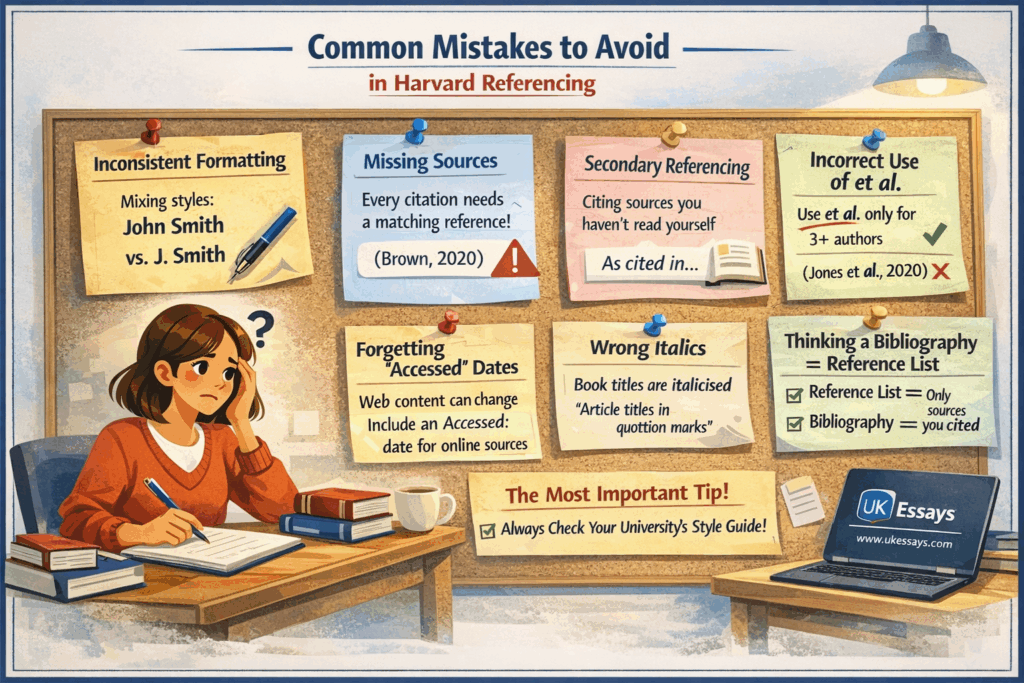
- Inconsistent formatting — Mixing styles (e.g., sometimes using first names, sometimes initials) is one of the most common errors markers spot.
- Missing sources — Every in-text citation must have a corresponding reference list entry, and vice versa.
- Referencing sources you haven’t read — If you found a quote in a textbook, cite it as a secondary reference. Don’t pretend you read the original.
- Forgetting “Accessed” dates for online sources — Web content can change or disappear; the access date records when you saw it.
- Incorrect use of et al. — Don’t use et al. for one or two authors. Don’t forget the full stop after “al.”
- Italicising the wrong elements — Book titles and journal names are italicised; article and chapter titles are not (they go in quotation marks).
- Confusing a reference list with a bibliography — A reference list includes only sources you cited. A bibliography includes everything you consulted, even if you didn’t cite it. Most assignments require a reference list unless otherwise specified.
- Not checking your university’s specific guide — This is the most important point. Harvard is a style family, not a single rulebook. Your institution’s version is the one that counts for your marks.
Quick-reference cheat sheet
| Situation | In-text example |
|---|---|
| One author | (Smith, 2021) |
| Two authors | (Smith and Jones, 2021) |
| Three+ authors | (Smith et al., 2021) |
| Author named in text | Smith (2021) argues… |
| Direct quote | (Smith, 2021, p. 45) |
| No author | (Department for Education, 2020) |
| No date | (Smith, no date) |
| Multiple sources | (Jones, 2018; Smith, 2021) |
| Same author, same year | (Smith, 2021a; Smith, 2021b) |
| Secondary source | (Smith, 2015, cited in Jones, 2021) |
Final checklist before you submit
- Every in-text citation has a matching reference list entry
- Every reference list entry has at least one corresponding in-text citation
- The reference list is in alphabetical order by surname
- Hanging indents are applied consistently
- Book titles and journal names are italicised
- Article and chapter titles are in quotation marks (not italicised)
- Page numbers are included for all direct quotations
- Et al. is used correctly and consistently
- Online sources include access dates
- You have followed your university’s specific Harvard guide
Getting Harvard referencing right is partly about knowing the rules and partly about being meticulous. The good news is that once you learn the underlying logic – author-date in the text, full details in the reference list – it becomes second nature.
Keep your university’s style guide bookmarked, use a reference manager for larger projects, and always leave time at the end of your writing process to check your references carefully. Markers notice, and it makes a real difference to your grades.
You can see more examples in our Harvard referencing guide.
Remember – you can use our free Harvard Referencing Generator to create easy references in seconds.
Need a complete model answer for your assignment?
An experienced specialist in your subject will write a complete model answer to your question, with Harvard referencing throughout.
Already written your draft? Get help with editing or get marking and feedback.
For those that like to listen to explanations here is an easy to follow tutorial.

Cite This Work
To export a reference to this article please select a referencing stye below: