
Hofstede’s cultural dimensions theory guide
Info: 2212 words (9 pages) Study Guides
Published: 20 Mar 2026
Still struggling to understand Hofstede’s theory? We can help! Check out our essay writing service on the management assignment help page.
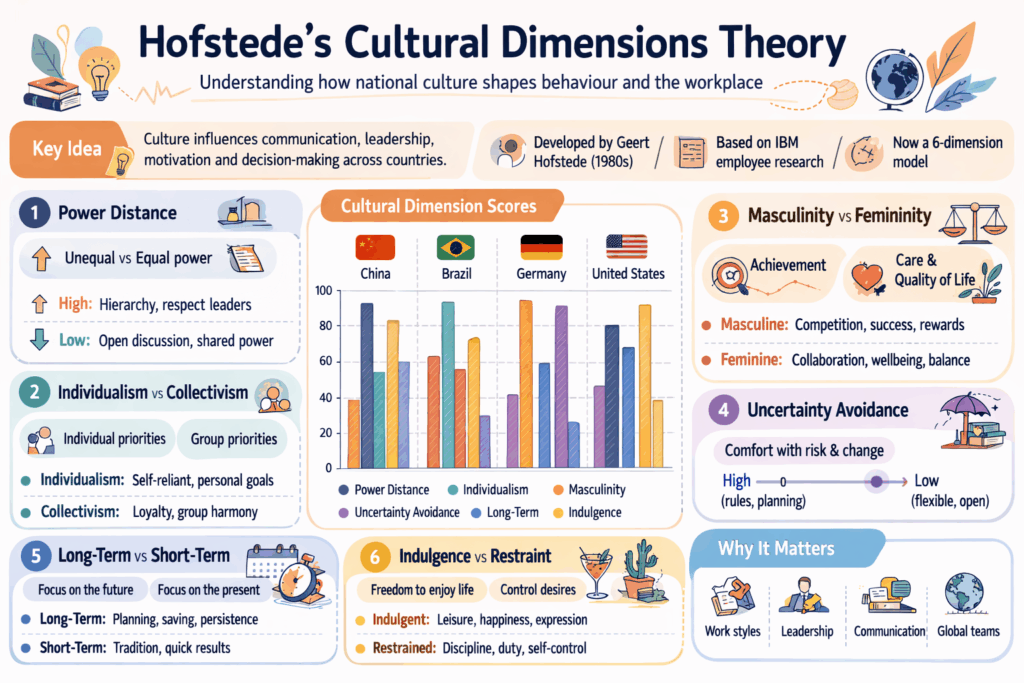
Hofstede’s cultural dimensions theory is a framework for understanding how core values in different societies influence behaviour and organisational practices.
It provides a set of dimensions along which cultures can be compared, helping to explain why people and institutions vary across countries in their social norms and workplace practices.
Developed by Dutch social psychologist Geert Hofstede in the late 20th century, the theory originally emerged from a large-scale survey of IBM employees across dozens of countries (Hofstede, 1980). This research identified patterns in how employees’ cultural backgrounds affected their work values, leading to an initial model of four dimensions.
Subsequently, researchers added two more dimensions to cover aspects of culture not captured in the original set (Bond, 1991; Hofstede and Minkov, 2010).
Today, Hofstede’s six cultural dimensions – power distance, individualism versus collectivism, masculinity versus femininity, uncertainty avoidance, long-term versus short-term orientation, and indulgence versus restraint. Form a widely used framework for comparing national cultures and improving cross-cultural understanding.
Comparison of cultural dimension scores for four countries (China, Brazil, Germany, and the United States) in Hofstede’s model.
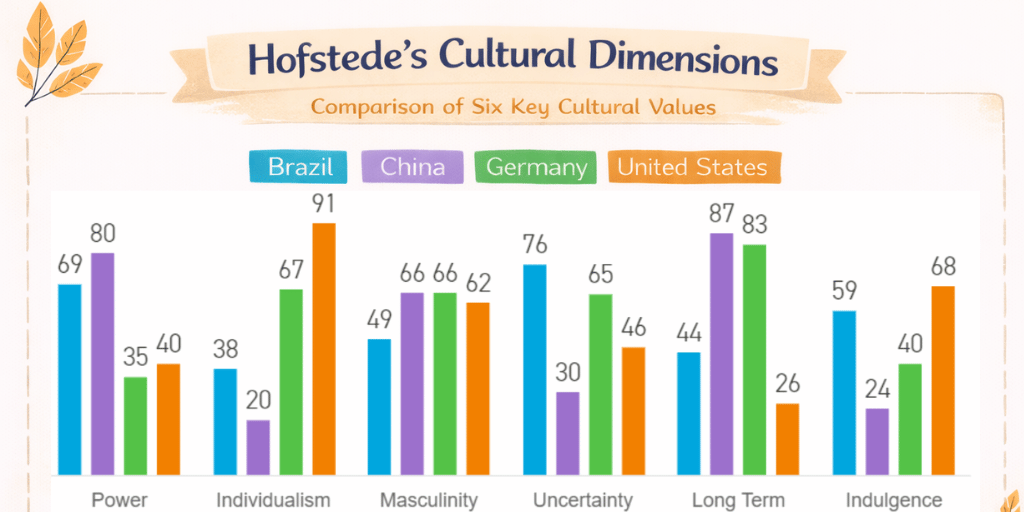
This chart illustrates how different societies can vary across all six of Hofstede’s dimensions in their cultural profiles.
Each country exhibits a unique pattern: for example, the United States scores very high on individualism but relatively lower on power distance, whereas China shows the opposite trend. Such comparative visuals help to demonstrate the diverse cultural tendencies that Hofstede’s data reveal among nations.
Power distance
Power distance describes the extent to which a society accepts that power is distributed unequally. In cultures with high power distance, people tend to expect a clear hierarchy and concentrate decision-making authority at the top. Subordinates are less likely to challenge or question their leaders, and inequality is seen as a natural part of society.
In low power distance cultures, by contrast, there is a preference for egalitarian relations and approachable leadership. Individuals in these societies expect power to be shared more equally, and they are more comfortable with questioning or offering input to authority figures.
For example, employees in a high power distance country might rarely contradict a manager’s instructions. Whereas in a low power distance setting it is common to openly discuss and debate decisions with one’s boss.
Individualism versus collectivism
Individualism versus collectivism refers to the degree to which people in a culture prioritise personal goals and individual rights as opposed to group goals and communal obligations.
In individualistic societies – such as the United States or Australia – individuals are expected to be self-reliant and to look after themselves and their immediate family. Personal achievement and independence are highly valued, and social ties beyond the nuclear family are more loosely defined.
In collectivist cultures – for example, Japan or Colombia – people are integrated into strong, cohesive in-groups (often extended families or communities) which continue protecting them in exchange for loyalty (Hofstede, 1991). Decisions in collectivist settings tend to be made with the group’s harmony and interests in mind rather than just individual preference.
Open disagreement may be avoided to preserve group cohesion, whereas in individualist cultures it is generally acceptable to voice personal opinions even if they diverge from the group.
Masculinity versus femininity
Masculinity versus femininity (sometimes also called achievement versus quality-of-life) is the dimension that examines a society’s orientation toward competitiveness and material success, as opposed to cooperation, care, and quality of life.
A “masculine” culture values traits such as assertiveness, ambition, and performance. Societies like Japan and Germany, which score high on masculinity, often emphasise competition, achievement in school or work, and recognition for success. There is a stronger differentiation of gender roles, and people are motivated by tangible accomplishments and rewards.
By contrast, a “feminine” culture places greater importance on relationships, well-being, and consensus. In countries like Sweden or the Netherlands, which rank as more feminine, policies and social norms tend to support work–life balance, social support systems, and caring for the less fortunate.
In the workplace, a masculine-oriented company might highlight aggressive targets and reward top performers with public recognition or bonuses. While a feminine-oriented organisation would more likely encourage collaboration, modesty, and the importance of team success and employee welfare.
Uncertainty avoidance
Uncertainty avoidance is the extent to which members of a culture feel threatened by ambiguous or unknown situations. The degree to which they have created beliefs and institutions to avoid such uncertainty. It indicates how comfortable a society is with risk, change, and unpredictability.
Cultures with high uncertainty avoidance, such as Greece or Japan, tend to have strict rules, formal structures, and clear guidelines in order to minimise the unexpected. People in these societies generally prefer stability, detailed planning, and established procedures; they may also exhibit higher levels of anxiety when facing the unknown. There is often a strong emphasis on formal laws, religious or cultural norms, and adherence to traditional ways.
In contrast, low uncertainty avoidance cultures – for example, Singapore or Denmark – are more accepting of variability and improvisation. In these societies, people tend to be more flexible and willing to take risks, and they operate with fewer regulations while showing greater tolerance for differences in behaviour or opinion. They often view rules as guidelines rather than absolutes.
For instance, businesspeople in a high uncertainty avoidance culture might insist on comprehensive contracts and risk assessments before embarking on a project. Whereas those in a low uncertainty avoidance environment may be comfortable starting with a rough plan and adjusting as they go.
Long-term versus short-term orientation
Long-term versus short-term orientation (also known as Confucian dynamism or pragmatic versus normative orientation) reflects a cultural preference for focusing on future rewards versus valuing tradition and the present.
In long-term oriented cultures, like China or South Korea, there is a strong emphasis on perseverance, planning, and thriftiness. People in these societies are willing to delay short-term gratification and successes in order to prepare for the future. They tend to adapt traditions if needed to achieve future goals, and they invest in education and innovation as a way to secure long-term benefits. The concept of saving face and maintaining social harmony for future advantage is also important.
In short-term oriented cultures, such as the United States or Nigeria, the focus is more on immediate results, personal stability, and respecting tradition or social obligations. These societies value quick outcomes and personal steadiness, with a desire to protect one’s reputation in the here and now. Traditions are upheld as guiding principles, and change is approached cautiously if it might disrupt established norms.
Hofstede’s fifth dimension of long-term orientation originated from research on East Asian cultural values (Bond, 1991), highlighting how Confucian philosophy influenced this future-oriented perspective.
Indulgence versus restraint
Indulgence versus restraint describes the degree to which cultures allow relatively free gratification of basic human desires related to enjoying life and having fun, versus regulating those desires through strict social norms.
Indulgent cultures, such as Mexico or Sweden, encourage people to indulge their impulses and pursue happiness. Societies with high indulgence tend to have a positive attitude towards leisure, place importance on personal freedom, and permit open expression of emotions. There is an expectation that individuals are free to pursue enjoyment and that indulging in life’s pleasures is natural.
By contrast, restrained cultures – for example, Russia or Egypt – emphasise duty, self-discipline, and the suppression of immediate gratification. In these societies, strict social norms regulate behaviour, and people may feel that indulging too much is inappropriate.
Happiness and leisure are not given the same priority as in indulgent cultures. Instead, adhering to rules, religious or cultural expectations, and working hard are valued more. Researchers identified this sixth dimension in later studies (Hofstede and Minkov, 2010). Capturing aspects of culture related to happiness and life satisfaction that the earlier dimensions did not address.
Applications of Hofstede’s theory
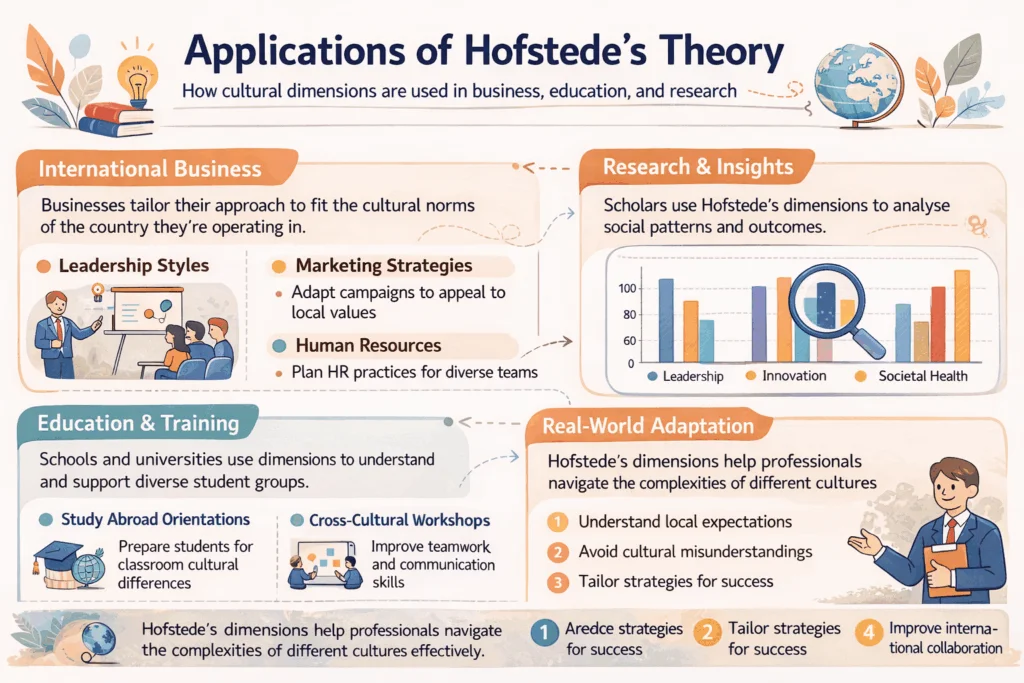
Hofstede’s cultural dimensions have proven useful in various real-world contexts. In international business and management, for instance, companies use these insights to tailor leadership styles, marketing strategies, and human resource practices to different cultural environments.
A manager working across countries may adjust their approach to decision-making or communication based on local cultural expectations. Adopting a more consultative style in low power distance cultures, or providing more structured guidance in high uncertainty avoidance settings.
Marketing campaigns are also designed with cultural values in mind: adverts in collectivist societies might emphasise family and community, whereas those in individualist markets highlight personal success and choice.
In education and training, understanding cultural dimensions helps teachers and institutions better serve diverse student populations. Educators preparing learners for study-abroad programmes often highlight differences such as attitudes towards authority in the classroom. For example, that students from high power distance cultures might be less inclined to challenge instructors openly, compared to students from low power distance backgrounds.
Cross-cultural training workshops in universities and companies similarly use Hofstede’s dimensions as a toolkit to raise awareness of how cultural backgrounds can affect learning styles, teamwork, and communication preferences.
Researchers in fields like cross-cultural psychology, sociology, and international relations also rely on Hofstede’s framework to examine how culture influences various social phenomena. The dimensions provide quantifiable indices, and researchers have linked these indices to differences in outcomes ranging from leadership styles and innovation rates to societal health indicators.
By using a common set of cultural metrics, scholars and practitioners can compare studies across countries and over time, gaining a deeper understanding of the role of culture in human behaviour and organisations.
Despite the emergence of alternative models and more recent datasets, Hofstede’s dimensions remain a foundational reference point for analysing cultural differences.
Criticisms and limitations
While Hofstede’s model is widely influential, researchers have raised several notable criticisms and caveats about its use.
A key concern is that the original data came from a single multinational company’s employees in the 1960s and 1970s (IBM). Which calls into question how well the findings represent entire national cultures (McSweeney, 2002). The survey sample – largely male, white-collar workers within one corporation – may not capture the full diversity of values in each country.
As a result, some scholars argue the model oversimplifies or misrepresents cultures by basing conclusions on a narrow subset of the population.
Another limitation is the risk of stereotyping and overgeneralisation. Hofstede’s framework assigns each country a score on each dimension. However within any nation there can be significant variation across regions, generations, ethnic groups, and social classes.
Treating a country as monolithic in its culture can lead to unfounded assumptions. For example, assuming every individual in a “high collectivism” society will be group-oriented in the same way. It is therefore crucial to use the dimensions as broad guidelines rather than definitive rules. Notably, Hofstede himself emphasised that cultural dimensions describe national averages and do not predict individual behaviour.
Additionally, cultural values and attitudes can change over time, which means scores from surveys conducted decades ago might not fully reflect a society’s current outlook. Rapid globalisation, technological advancements, and social change have shifted norms in many places (Orr and Hauser, 2008).
For instance, attitudes toward gender roles (captured by the masculinity versus femininity dimension) have evolved considerably in numerous countries since the 1980s. Without periodic updates, the model could become dated or misleading.
Some later studies have attempted to remeasure and refine the dimensions, and new frameworks have been proposed to complement Hofstede’s work, indicating that cultural research is an ongoing process.
Conclusion
Hofstede’s cultural dimensions theory offers a powerful tool for making sense of international differences in social values and organisational practices. By distilling complex cultural patterns into six core dimensions, it enables academics and professionals to discuss and compare cultures in a structured way.
Scholars and practitioners have applied the framework in a wide array of fields – from global business management to psychology and education – demonstrating its practical value in bridging cultural gaps.
At the same time, a nuanced understanding of the model’s limitations remains important. Users of Hofstede’s dimensions should avoid rigid interpretations and consider the context of specific groups or changing times. When applied thoughtfully, the cultural dimensions serve as a starting point for deeper intercultural insight, helping people and organisations navigate the challenges and richness of our diverse world.
For further reading around the subject you may be interested in these two articles. Hofstede and Trompenaar’s Cultural Dimensions and the Kluckhohn and Fred Strodtbeck model.
Still struggling to understand Hofstede’s theory? We can help! Check out our essay writing service on the management assignment help page.
References
- Bond, M. H. (1991). Beyond the Chinese face: Insights from psychology. Oxford University Press, USA.
- Hofstede, G. (1980). Culture’s Consequences: International differences in work-related values. Beverly Hills, CA: Sage.
- Hofstede, G. (1991). Cultures and Organizations: Software of the mind. London: McGraw-Hill.
- Hofstede, G. (2011). Dimensionalizing cultures: The Hofstede model in context. Online Readings in Psychology and Culture, 2(1).
- Hofstede, G., & Minkov, M. (2010). Long-versus short-term orientation: new perspectives. Asia Pacific Business Review, 16(4), 493–504.
- McSweeney, B. (2002). Hofstede’s model of national cultural differences and their consequences: A triumph of faith – a failure of analysis. Human Relations, 55(1), 89–118.
- Orr, L. M., & Hauser, W. J. (2008). A re-inquiry of Hofstede’s cultural dimensions: a call for 21st century cross-cultural research. Marketing Management Journal, 18(2), 1–19.

Cite This Work
To export a reference to this article please select a referencing stye below: