
How many references should an essay include?
Info: 2034 words (8 pages) Blog
Published: 15 Apr 2026

UK Essays writing support
Writing an essay with academic references?
We’ll write a complete model essay to answer your question, with relevant academic sources, citations and a reference list.
Send us your question and, if you wish, any marking criteria. An experienced specialist in your subject will write your model answer from scratch.
All our writers hold at least a 2:1 degree from a reputable university. Most hold a master’s degree or PhD, and/or have teaching experience.
Writing an academic essay requires supporting your points with evidence from credible sources, but there is no single “magic number” of references that fits every situation.
Different universities in the UK offer various guidelines emphasising that the appropriate number of references depends on factors like essay length, subject, and level of study.
Below, we review and summarise guidance from a range of UK universities and writing resources to help you.
University of Edinburgh
Guidance from a lecturer at the University of Edinburgh similarly stresses “it depends” when students ask how many sources to use. Rather than a fixed count, the number of references should reflect the depth and breadth of your reading.
For example, in a typical 1,500 – 2,000 word undergraduate essay, it notes that:
- A passing essay (score in the 50s) might use roughly 4 – 5 sources.
- A 2:1-level essay (60s range) often uses 5 – 10 sources.
- A first-class essay (70+ range) tends to integrate around 8 – 15 scholarly sources.
These figures are rough estimates, not strict requirements. A brilliantly argued essay could earn a top grade with fewer sources, and conversely, an essay with dozens of references could still score poorly if the argument is weak.
The key is that higher-quality essays typically demonstrate wider reading and engagement with multiple perspectives.
They also point out that the nature of the question influences how many sources you’ll need: a purely theoretical question (focused on one author or concept) may require fewer sources than a broad topic or a comparative question that spans many viewpoints.
University of Southampton
The University of Southampton’s Business School provides a handy rule of thumb in an “unofficial” student guide.
The “official answer” to how many references you need is simply “as many as you need”, i.e. enough to support all your points.
However, for students looking for more concrete guidance, the guide recommends “about one source in your bibliography per 100 words” of essay length. This works out to roughly 10 sources per 1,000 words.
They caution that this rule is arbitrary and not a strict limit. In practice, there’s no such thing as too many references so long as each citation is relevant (and you’re not citing general common knowledge). This guideline simply encourages consistent use of sources throughout your writing – for example, a 2000-word essay might commonly have on the order of 20 sources, evenly distributed, if one follows the rule of thumb.
The emphasis is on ensuring each claim is backed by evidence, rather than aiming for a specific count.
Sheffield Hallam University
Sheffield Hallam University’s advice to students is that the number of references will vary with the assignment, and there is no easy formula.
Their guidance notes that “many students ask how many references they should use in an essay”, but the general principle is to demonstrate that “you have read adequately” for the task. In other words, you must show through your citations that you’ve engaged with enough relevant literature to support your arguments, rather than just writing from personal opinion or common knowledge.
Hallam’s guide emphasises using a range of sources in your work – more than one book or article – and ensuring each reference is relevant to the point you are making.
The focus is on quality and relevance: the sources should be credible academic or professional sources that bolster your argument, and all ideas from those sources must be properly cited to avoid plagiarism.
Essentially, you should include as many references as needed to cover different viewpoints and evidence for your topic, showing the breadth of your research. If unsure, Hallam suggests looking at the assignment brief or marking criteria for any hints (some tutors or rubrics may indirectly indicate an expected range of reading).
Wrexham Glyndwr University
Guidance from Wrexham Glyndwr University states that “there are no definitive answers” to the question of how many references to use. The requirements vary by discipline and by the nature of the assignment.
For instance, a literature review or research report might naturally call for a long list of sources, whereas a reflective essay or a critique of a single work might use fewer.
Glyndwr advises students to consult their lecturers or assignment instructions for any specific expectations.
The key takeaway is that you should tailor your referencing to the context: different subjects have different norms (e.g. a history essay might cite many primary and secondary sources, while a mathematics or programming assignment might have very few references).
Always check if your department provides any guidance like “at least X sources” or recommended reading lists. In the absence of a set number, use your judgment to ensure you’ve included all necessary sources to support your arguments thoroughly.
Norwich University of the Arts
At Norwich University of the Arts (NUA), students writing a third-year 5,000-word report are told that “there is no fixed number of references” required. Instead of focusing on a number, NUA stresses that a 5,000-word research report is a “substantial piece of written work” that should “draw on a variety of reliable, academic sources.”. In other words, the bibliography should evidence that you’ve done significant research.
Tutors will be looking not for a specific count of references, but for good-quality evidence in your discussion and a bibliography that reflects the research you put into the project. This means you should use enough sources to cover the key points and theoretical frameworks of your topic, and those sources should be authoritative (e.g. scholarly books, journal articles, reputable publications).
Even in art and design fields, where a report might include creative practice, the expectation is that you contextualise your work with relevant literature and sources. So, while there’s no numeric threshold, a successful 5,000-word paper would typically reference numerous sources—demonstrating a mix of breadth (variety of sources) and depth (credible academic material) in research.
Differences by level of study (undergraduate vs postgraduate)
Many universities note that expectations for research and referencing scale up with the level of study. Undergraduate essays often have more constrained reading lists, whereas postgraduate assignments (and especially dissertations) require broader and deeper research.
For example, the University of Hull explains that at postgraduate level, reading lists are much more extensive than at undergraduate level, because students must engage with a wide range of perspectives and delve more deeply into the literature to develop their arguments.
In practical terms, a Masters essay or dissertation will generally incorporate more references than an undergraduate essay of the same length, reflecting the greater emphasis on independent research and critical analysis.
By the time you reach PhD level, the expectation is that you perform an exhaustive literature review of your research area – PhD theses (which might be ~80,000 words) can easily include hundreds of references as they must cite foundational works, current studies, and relevant theory in the field.
The exact number will depend on the discipline (for instance, a humanities PhD might cite more sources than a STEM PhD focusing on a narrower experimental question), but in all cases the principle is the same: use as many sources as needed to thoroughly support and situate your work in existing scholarship.
There is no upper limit other than practicality – every citation should serve a purpose. As one guide put it, “there can never be too many references” in your work, as long as you’re not padding the essay with irrelevant or repetitive sources.
The depth of your research should match the level of your study: higher levels demand a more comprehensive engagement with the literature.
Key takeaways:
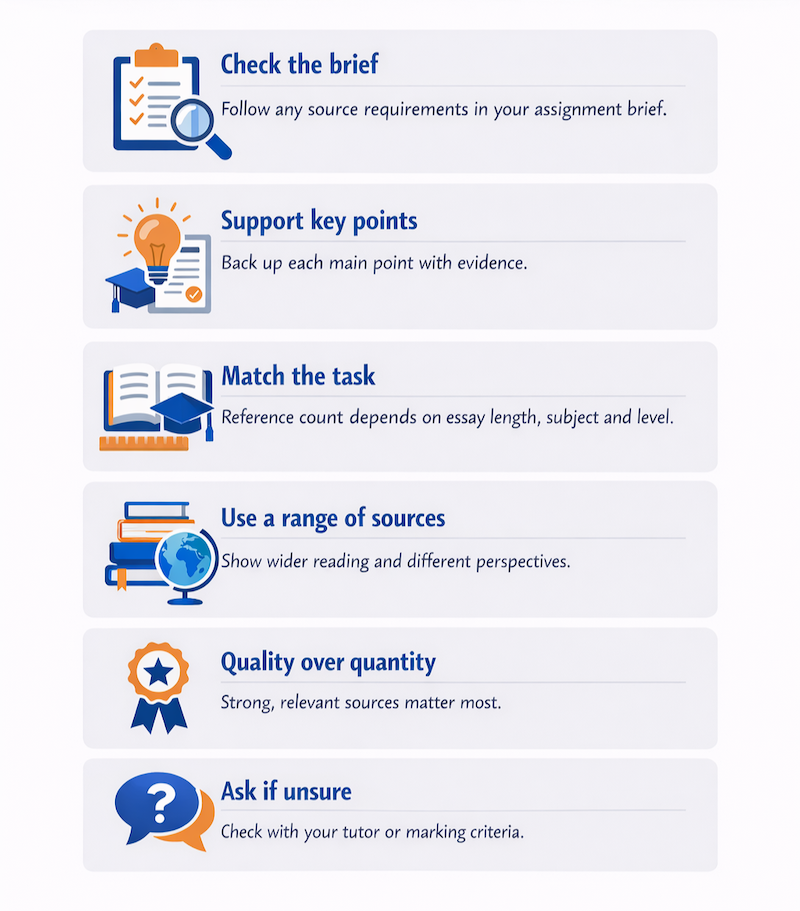
UK universities consistently emphasise quality and relevance of sources over sheer quantity. There is no one-size-fits-all reference count, but here are some general guidelines drawn from the university advice above:
Meet any stated requirements:
Always check your module guide or assignment brief. If it specifies a number or range of sources (though rare, some assignments might), follow that. Otherwise, use the guidelines below.
Use sources to support every key point:
Aim to back up each important claim or idea in your essay with a citation (or more than one if it’s a contested point). A common practice is having at least one or two references per paragraph in an academic essay, depending on the content of that paragraph. This ensures your writing is anchored in evidence.
Aim for a proportional number of references given the essay’s length:
While not a hard rule, a rough heuristic is about 1 reference per 100–150 words of essay. For example, a 1000-word essay might cite ~8–12 sources, and a 3000-word essay might have on the order of 20–30 sources. This aligns with advice from Southampton (≈1 per 100 words) and other academic skills sources. Longer research essays or theses will naturally require more.
Ensure a range of sources:
Don’t rely on just one or two sources for your entire essay. Markers expect a range of perspectives and sources to show you’ve done broader reading. Even if your essay’s focus is a single work or theory, you should include references to commentators, critics, or related research to enrich your discussion.
Consider the subject and question:
Different subjects have different norms. A science lab report might cite fewer sources (but very current journal articles), whereas a literature essay might reference many critics and interpretations. Also, the type of question matters – a comparative or survey question needs more sources than a tightly focused question on one concept. Adjust your referencing breadth accordingly.
Prioritise quality over quantity:
It’s better to have 10 well-chosen, relevant references than 30 irrelevant or superficial ones. Markers look for credible, academic sources and how well you integrate them into your argument. Dropping in extra references just to hit a high number won’t fool anyone and can even weaken the essay if those sources don’t truly support your points. Always ask yourself: “Is this reference necessary and appropriate here?” If yes, include it and cite it properly; if not, don’t add it merely to pad your list.
When in doubt, ask:
If you’re unsure whether you have “enough” references, seek guidance from your instructor or a writing tutor. They can give insight into what is expected for a given assignment in a given course. Also, reviewing marking criteria can help – often, criteria for higher marks include evidence of wider reading. This is a clue that using more high-quality sources (and synthesizing them well) can boost your grade.
Remember that referencing is not just a numbers game. The ultimate goal is to ground your arguments in existing knowledge and give credit to other authors. As long as you do that thoroughly and thoughtfully, you will likely have “enough” references for your essay’s purpose. Each of the university sources above converges on the idea that context matters – the level of study, the subject discipline, the type of question, and the length of the assignment all inform how many references you might use. Use these university guidelines as a reference point, but always tailor your approach to the specific task at hand. By focusing on solid research and clear, supported arguments, you will naturally produce a well-referenced essay.
Need a complete model essay for your question?
An experienced specialist in your subject will write a complete model essay to answer your question from scratch.
Already written your draft? Get help with editing or get marking and feedback.
Sources:
- University of Edinburgh – How many sources should I use in my essay? (The Critical Turkey)
- University of Southampton Business School – The Unofficial First Year Guide
- Sheffield Hallam University – Assignment Guidance
- Wrexham University – Harvard Referencing
- Norwich University of the Arts – Research Report Guidelines 2024–25
- University of Hull Online – 5 differences between undergraduate and postgraduate study

Cite This Work
To export a reference to this article please select a referencing stye below: